Skip Navigation Links weather.gov 
NOAA logo - Click to go to the NOAA homepage National Weather Service   NWS logo - Click to go to the NWS homepage
The Weather Prediction Center


Follow the Weather Prediction Center on Facebook Follow the Weather Prediction Center on X
WPC Home
Analyses and Forecasts
   National High & Low
   WPC Discussions
   Surface Analysis
   Days ½-2½ CONUS
   Days 3-7 CONUS
   Days 4-8 Alaska
   QPF
   PQPF
   Flood Outlook
   Winter Weather
   Storm Summaries
   Heat Index
   Tropical Products
   Daily Weather Map
   GIS Products
Current Watches/
Warnings

Satellite and Radar Imagery
  GOES-East Satellite
  GOES-West Satellite
  National Radar
Product Archive
WPC Verification
   QPF
   Medium Range
   Model Diagnostics
   Event Reviews
   Winter Weather
International Desks
Development and Training
WPC Overview
   About the WPC
   WPC History
   Other Sites
   FAQs
Meteorological Calculators
Contact Us
   About Our Site
 
USA.gov is the U.S. Government's official web portal to all federal, state, and local government web resources and services.
 
Excessive Rainfall Discussion
 
(Caution: Version displayed is not the latest version. - Issued 1557Z Jul 19, 2026)
 
Version Selection
Versions back from latest:  0   1   2   3   4   5   6   7   8   9   10   11   12   13   14   15   16   17   18   19   20   
 
Abbreviations and acronyms used in this product
 
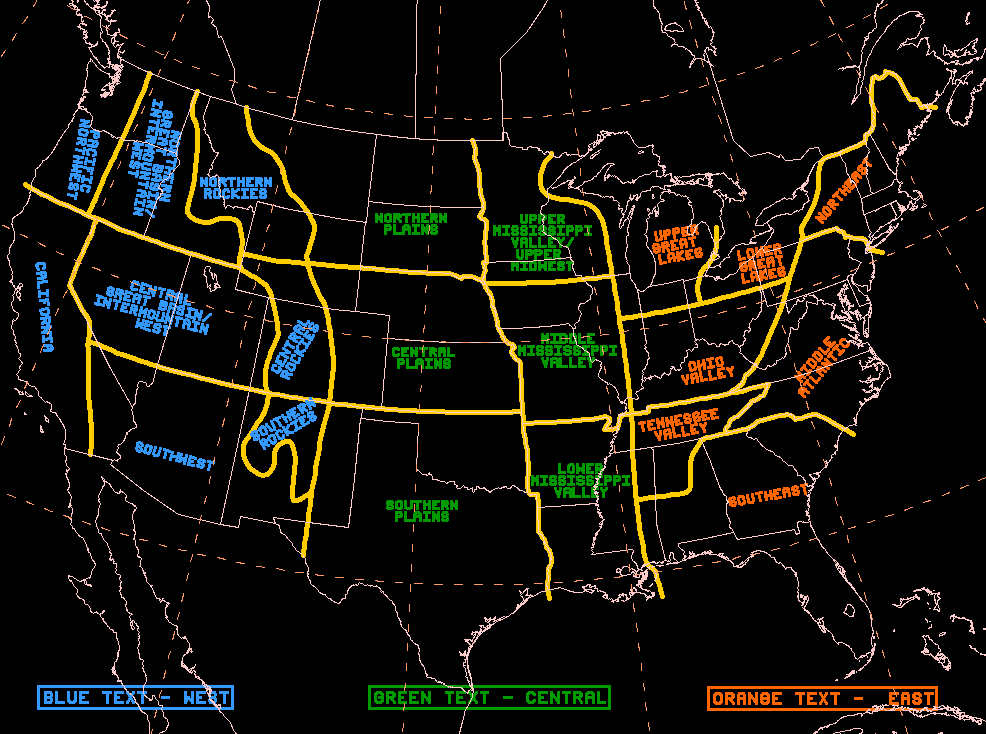
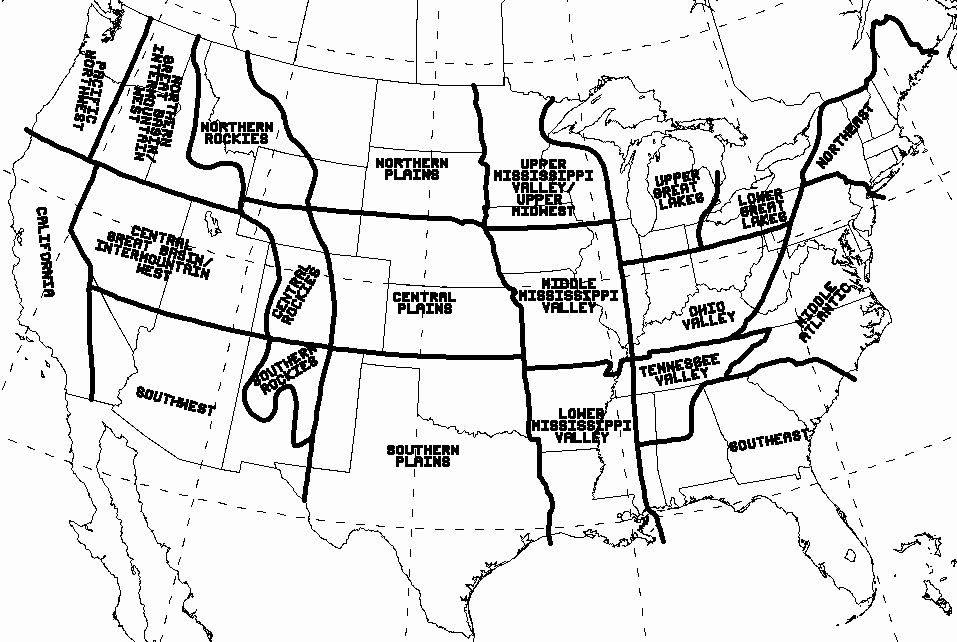
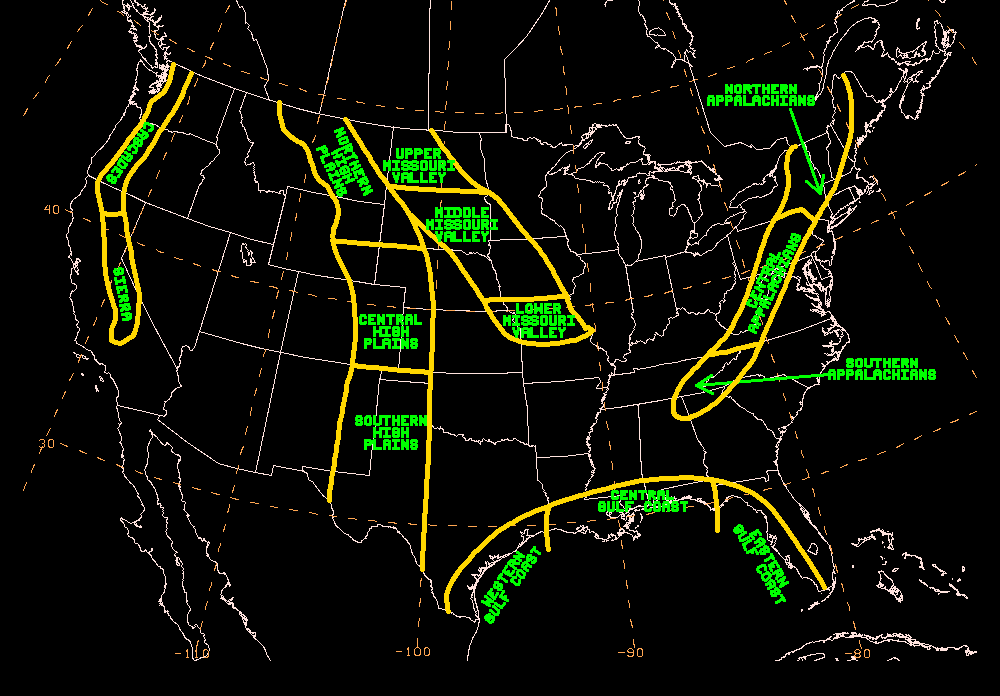
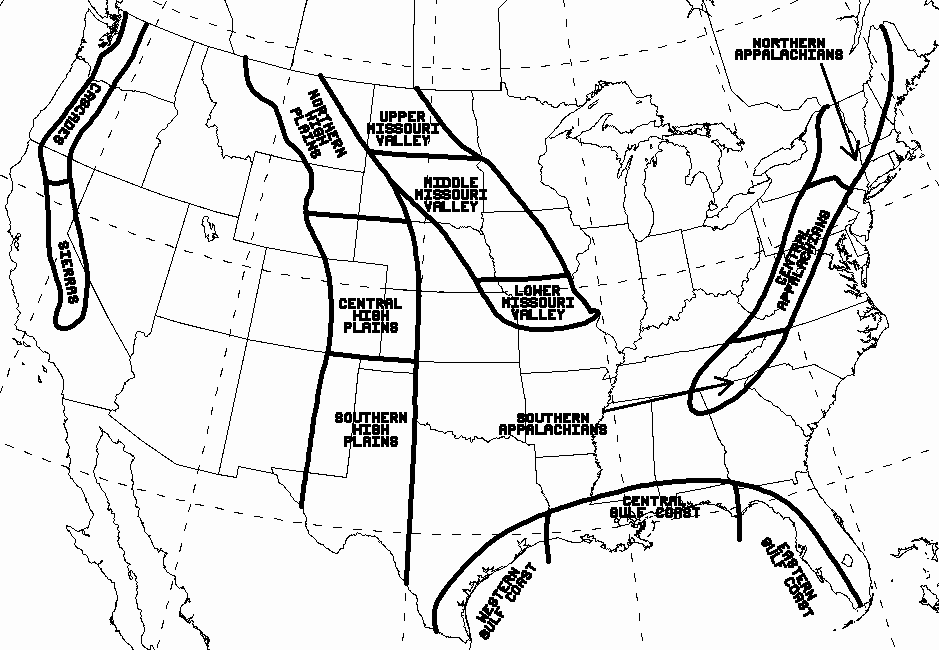
Geographic Boundaries -  Map 1: Color  Black/White       Map 2: Color  Black/White


Excessive Rainfall Discussion
NWS Weather Prediction Center College Park MD
1156 AM EDT Sun Jul 19 2026

Day 1
Valid 16Z Sun Jul 19 2026 - 12Z Mon Jul 20 2026

...THERE IS A SLIGHT RISK OF EXCESSIVE RAINFALL FOR PORTIONS OF THE
SOUTHWESTERN U.S. FROM WEST TEXAS TO SOUTHWESTERN UTAH, AND EASTERN
NORTH CAROLINA AND THE VIRGINIA TIDEWATER REGION...

...Southwestern U.S...

Overall, the synoptic pattern remains much the same, with the
monsoon ridge remaining favorably aligned. PW anomalies of 2-3
standard deviations above normal will remain across much of the
highlighted area. This moisture, along with sufficient instability,
and areas of enhanced ascent afforded by easterly-drifting mid-
level energy will support another day of scattered to widespread
convective activity. Slow storm motions along with cell mergers
will raise the threat for locally heavy amounts and flash flooding
concerns, particularly for slot canyons, dry washes, burn scars,
and low desert areas via mountain outflows. The Slight Risk
highlights the area where HREF and REFS guidance indicate the
threat for 1-2 inch amounts is greatest. The main change from
overnight is a reduction in the northward extent of the Slight Risk
area over Utah, now confined to far southwestern Utah. Warmer 700mb
temperatures north of the Grand Canyon will likely limit the areal
coverage of convection, with a broad Marginal Risk remaining
valid.

...Lower Missouri Valley to Southeastern Virginia and Eastern North
Carolina...

A targeted Slight Risk remains centered over eastern North
Carolina and extends into southeastern Virginia. Convection will
develop ahead of a slow-moving cold front that will be dropping
south into a very moist (PWs 2+ inches) and unstable (MUCAPE >
2000 J/kg) environment, while some modest right-entrance region
upper jet forcing will offer some enhanced ascent. Heavy totals
appear likely, with both the HREF and REFS showing high
neighborhood probabilities for some 2 to 4 inch totals within the
Slight Risk area, mainly between the Hampton Roads area and
Morehead City. There was a minor northward adjustment of the
Marginal and Slight Risk areas across central Virginia to account
for the latest model trends compared to the overnight issuance.

Less organized activity is expected back along the front extending
across the southern Appalachians, Tennessee Valley, and parts of
the lower Ohio, mid Mississippi, and lower Missouri valleys. While
widespread heavy totals are not expected, the moisture-rich
environment (PWs 1.75-2 inches) is expected to support storms
capable of producing localized heavy amounts and isolated runoff
concerns.

...Eastern Dakotas into the upper Mississippi Valley...

A shortwave moving off of the top of the western U.S. ridge will
interact with a frontal system advancing through the northern
Plains into the Upper Midwest. An amplifying west-southwesterly
low level jet will support increasing PWs (1.75-2 inches) and
instability ahead of a frontal boundary. The models have trended the
axis of heaviest rainfall farther north into central and northern
Minnesota, and therefore the existing Marginal Risk area has been
extended to the Minnesota/Canada border. Any new burn scar areas
will be more susceptible to potential flood issues.

...Eastern Gulf Coast into the Southeast...

Newly formed Tropical Depression Two is idling in place across the
northeastern Gulf about 150 miles south of Panama City, Florida.
Recent radar imagery indicates the core of convection and heaviest
rainfall well offshore, and the latest CAM guidance suite
suggests this will remain the case going through the remainder of
the afternoon and into tonight. However, some heavier amounts
along the west coast of Florida are likely with outer feeder bands
and could lead to some localized instances of flooding where
training convection develops. Therefore, the Marginal Risk was
maintained from the overnight issuance.

An axis of enhanced low level convergence and pooling moisture to
the north is still expected be a focus for diurnal storms capable
of producing heavy rainfall rates. Therefore, a Marginal Risk was
maintained from the central Gulf Coast northward into the Tennessee
Valley. Recent CAM guidance indicate localized totals of 1 to 3 inches
across portions of this region through early evening where the most
persistent convection develops.

Pereira/Hamrick


Day 2
Valid 12Z Mon Jul 20 2026 - 12Z Tue Jul 21 2026

...THERE IS A SLIGHT RISK OF EXCESSIVE RAINFALL OVER PORTIONS OF
WEST TEXAS, NEW MEXICO, AND ARIZONA...

...Southwest and Great Basin...
Mid-level energy moving west of the region, and dry air advection
from the south will begin to diminish the heavy rainfall and flash
flooding threat over West Texas. However farther west, the
monsoonal moisture plume will remain firmly in place, ensuring
another day of high-efficient rainfall production over portions of
the Southwest and Great Basin.

Models show the upper high originally centered over Utah and
Colorado beginning to slide southeast, allowing moisture and
energy to spread northwest into the Great Basin and along the
western slopes of the Sierra Nevada -- raising the potential for
increasing storm activity and isolated runoff concerns in those
area.

The greater heavy rainfall and flash flooding threat will remain
focused from southwestern New Mexico and southeastern Arizona
northwestward along the Mogollon Rim into northwestern Arizona.
This is expected to be the focus for better synoptic forcing and
greater instability -- supporting intense short-duration rain rates
that will elevate the risk for flash flooding, especially in areas
of complex terrain, dry washes, and burn scars.

...Upper Great Lakes...
An amplifying upper trough supported by energy diving out of
Canada will advance from the upper Mississippi Valley to the upper
Great Lakes. Strong southwesterly to west-southwesterly low level
inflow will continue to sustain deep moisture ahead of the cold
front and across the advancing warm front. This moisture along with
strong forcing, produced in part by left-exit region upper jet
dynamics, will generate organized convection capable of producing
rainfall rates of 1-2 in/hr. Fast storm motions should limit the
overall heavy accumulation and flash flooding threat. However,
localized short-term training could raise at least some isolated
concerns.

...North Carolina and Southern Virginia...
Maintained a Marginal Risk across this area. Apart from the GFS and
REFS, the general model consensus indicates that activity will be
less organized. However, a lingering boundary and corresponding
pool of deep moisture (PWs 2+ inches) will support additional
storms capable of producing heavy downpours. Should the guidance
begin to trend more toward the GFS and REFS, a targeted upgrade
may required, especially if more models begin to show back-to-back
days of overlapping heavy amounts.

...Gulf Coast...
The models continue to show the footprint of the heaviest amounts
associated with the disturbance over the northern Gulf remaining
mostly offshore. Therefore maintained only a Marginal Risk along
the coast from West Florida to southeastern Louisiana. Moisture
pooling along an axis of enhanced low level convergence northwest
of the circulation may extend the threat for heavy rainfall further
inland into the far lower Mississippi Valley.

Pereira


Day 3
Valid 12Z Tue Jul 21 2026 - 12Z Wed Jul 22 2026

...THERE IS A SLIGHT RISK OF EXCESSIVE RAINFALL FOR PORTIONS OF THE
SOUTHWEST, CENTRAL APPALACHIANS, OHIO VALLEY, AND THE MID ATLANTIC
COAST...

...Southwest to the northern Rockies...
Models show the upper high continuing to shift east as an upper
trough begins to drift into the Pacific Northwest. This will allow
the monsoon moisture plume to spread further north, with moisture
anomalies over 3 std dev above normal extending as far north as the
northern Rockies. This will support increasing convective
development with isolated flash flooding concerns as far north as
southwestern Montana and southern Idaho.

However, the greater heavy rainfall and flash flooding threat is
expected to remain centered over western New Mexico, Arizona, and
southern Utah. Guidance shows a fairly well-defined shortwave
moving around the western periphery of the upper high, which along
with PWs over 1.5 inches in many spots, and highly sensitive soils,
will likely generate additional widespread storm coverage and flash
flooding concerns. Given the synoptic setup and anomalous
moisture, this can be considered a high-end Slight for parts of the
region and a future upgrade may be required.

...Central Appalachians and Ohio Valley...
A Slight Risk remains in place across portions of the central
Appalachians and Ohio Valley. Moist soils and flood-prone mountain
terrain are likely to contribute to the flash flood threat across
this region. Deep moisture (PWs around 2 inches) will fuel showers
and storms ahead of a strong cold front advancing southeast across
the region. These storms will be capable of producing 1-2 in/hr
rainfall rates, raising flash flooding concerns.

...Mid Atlantic...
A separate Slight Risk has been introduced along the Mid Atlantic
Coast for late Tuesday into early Wednesday. Strengthening
southeasterly flow ahead of the system moving through the Ohio
Valley will transport a deeply anomalous moisture plume into a
region of strong ascent. This combination will support increasing
coverage of showers and storms capable of producing heavy rainfall.
While the exact spatial coverage of heaviest amounts remains
somewhat uncertain, portions of the the more flood-prone urbanized
I-95 corridor appear to likely be impacted, warranting the upgrade
to a Slight Risk.

...Gulf Coast...
With the heavy rainfall footprint associated the Gulf disturbance,
remaining offshore in most of the guidance, continued to maintain
only a Marginal Risk along parts of the immediate Gulf Coast.

Pereira


Day 4 and Day 5
Valid 12Z Wed Jul 22 2026 - 12Z Fri Jul 24 2026

...THERE IS A SLIGHT RISK OF EXCESSIVE RAINFALL FOR THE COASTAL
CAROLINAS AND SOUTHEAST VIRGINIA ON BOTH WEDNESDAY AND THURSDAY...

...THERE IS A SLIGHT RISK OF EXCESSIVE RAINFALL FOR PORTIONS OF THE
INTERMOUNTAIN WEST ON WEDNESDAY...

...Tidewater Region of Virginia and the Carolinas...

A slow-moving cold front pushing southeast out of the Mid-Atlantic
on Wednesday is likely to continue slowing down its forward speed
as it approaches the Tidewater Region of Virginia and the Carolinas
on Wednesday. Meanwhile, plentiful tropical moisture will be drawn
northeastward from the tropical system that will likely be
meandering somewhere near the Louisiana coast on Wednesday. This
moisture will ride northeastward ahead of the front, spiking PWATs
above 2.25 inches over this entire region. The result of a strong
but slow-moving front, well above normal amounts of moisture, and
upper level support in the form of a deep trough over the Northeast
supporting the surface front from behind/north will make for a
nearly ideal scenario for training and backbuilding storms from the
afternoon through the evening.

This Day 4/Wednesday period is likely to be the fourth consecutive
day that showers and thunderstorms have been dropping locally very
heavy rain and multiple-inch rainfall totals somewhere in and
around eastern North Carolina. The front will act to greatly expand
the footprint of heavy rainfall in this area. Since soils are all
but certain to be nearly saturated in this area by Wednesday, flash
flooding concerns continue to increase. Thus, a higher-end Slight
was introduced with this update from Raleigh east, and from
Wilmington north through the Hampton Roads area. It's probable that
should the trends continue to increase both with the expected
rainfall on Wednesday, and the prior days' rainfall in this same
region, that a Moderate Risk upgrade will be needed with future
updates.

By Day 5/Thursday, the front will sag a hair bit further south,
likely sparing the Raleigh and Hampton Roads metros from much
additional rainfall, but instead concentrating the heaviest rains
from the Outer Banks southwest down the coast through Wilmington
and including Charleston, SC in heavy rainfall. The ERO thus was
started this morning with a Slight Risk for this area. Of course,
even just a small increase in forward speed will push the front up
to the coast, which would then concentrate all of the heaviest
rains off the coast, making the Slight Risk an over-forecast.
However, any slower/westward positioning of the front will make
for a 5th consecutive day of heavy rains in eastern North
Carolina...meaning the Slight Risk would be an under-forecast.
Thus, the Slight represents the "happy medium" of these scenarios
and fits best with the current rainfall forecast in the area for
Thursday.

...Intermountain West...

A Slight Risk upgrade was introduced with this update for a portion
of the Intermountain West on Wednesday. The area highlighted
includes all of southeastern Idaho, much of western Wyoming outside
of Yellowstone, as well as far northern Utah and the northwestern
corner of Colorado. Well above normal amounts of atmospheric
moisture to the tune of up to 4 sigma above normal, and PWATs
locally exceeding 1.25 inches will be in place across this region.
An approaching longwave trough will direct a strong shortwave
northeastward during the afternoon hours. This will result in
widespread shower and thunderstorm activity over this area.
Topographic interaction with the storms will locally enhance
rainfall rates, while also supporting impactful flash flooding as
the rain water races down the slopes of the mountains. Due to the
abundant moisture available, the storms will not only be numerous,
but capable of 2 inch/hour rainfall rates with the strongest cores,
a phenomenon not often seen in this part of the country.

Wegman


Day 1 threat area: www.wpc.ncep.noaa.gov/qpf/94epoints.txt
Day 2 threat area: www.wpc.ncep.noaa.gov/qpf/98epoints.txt
Day 3 threat area: www.wpc.ncep.noaa.gov/qpf/99epoints.txt