Skip Navigation Links weather.gov 
NOAA logo - Click to go to the NOAA homepage National Weather Service   NWS logo - Click to go to the NWS homepage
The Weather Prediction Center


Follow the Weather Prediction Center on Facebook Follow the Weather Prediction Center on X
WPC Home
Analyses and Forecasts
   National High & Low
   WPC Discussions
   Surface Analysis
   Days ½-2½ CONUS
   Days 3-7 CONUS
   Days 4-8 Alaska
   QPF
   PQPF
   Flood Outlook
   Winter Weather
   Storm Summaries
   Heat Index
   Tropical Products
   Daily Weather Map
   GIS Products
Current Watches/
Warnings

Satellite and Radar Imagery
  GOES-East Satellite
  GOES-West Satellite
  National Radar
Product Archive
WPC Verification
   QPF
   Medium Range
   Model Diagnostics
   Event Reviews
   Winter Weather
International Desks
Development and Training
   Development
WPC Overview
   About the WPC
   WPC History
   Other Sites
   FAQs
Meteorological Calculators
Contact Us
   About Our Site
 
USA.gov is the U.S. Government's official web portal to all federal, state, and local government web resources and services.
 
Winter Weather Forecast Discussion
 
(Caution: Version displayed is not the latest version. - Issued 0716Z Feb 10, 2026)
 
Version Selection
Versions back from latest:  0   1   2   3   4   5   6   7   8   9   10   
 
Abbreviations and acronyms used in this product
 
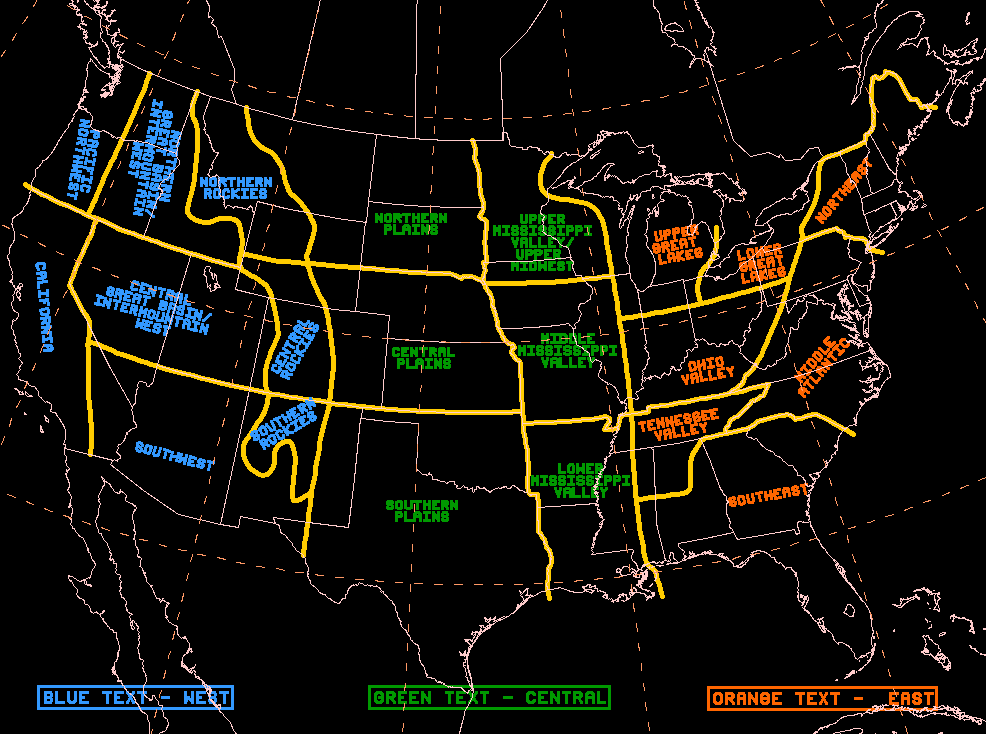
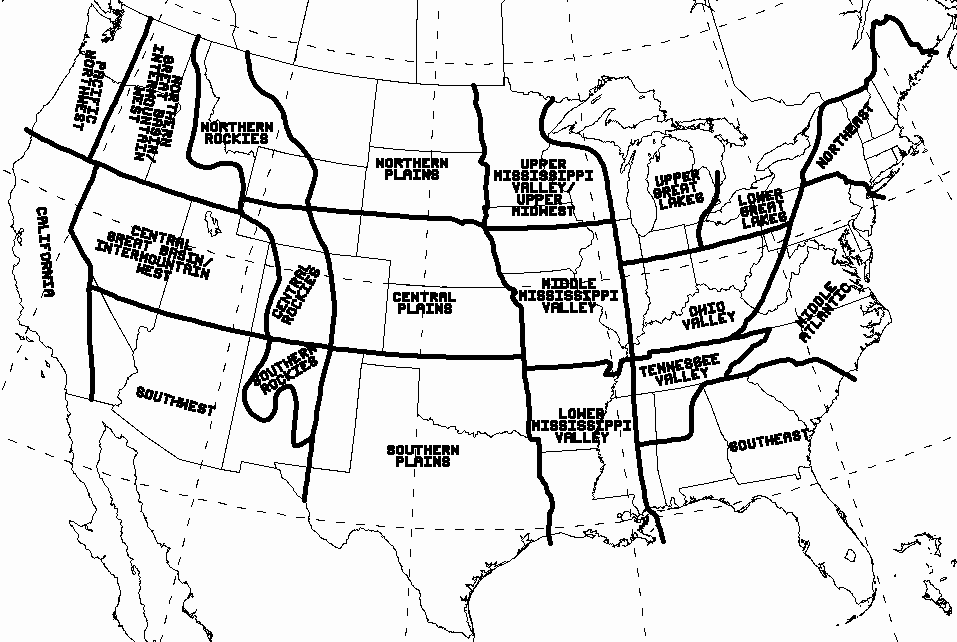
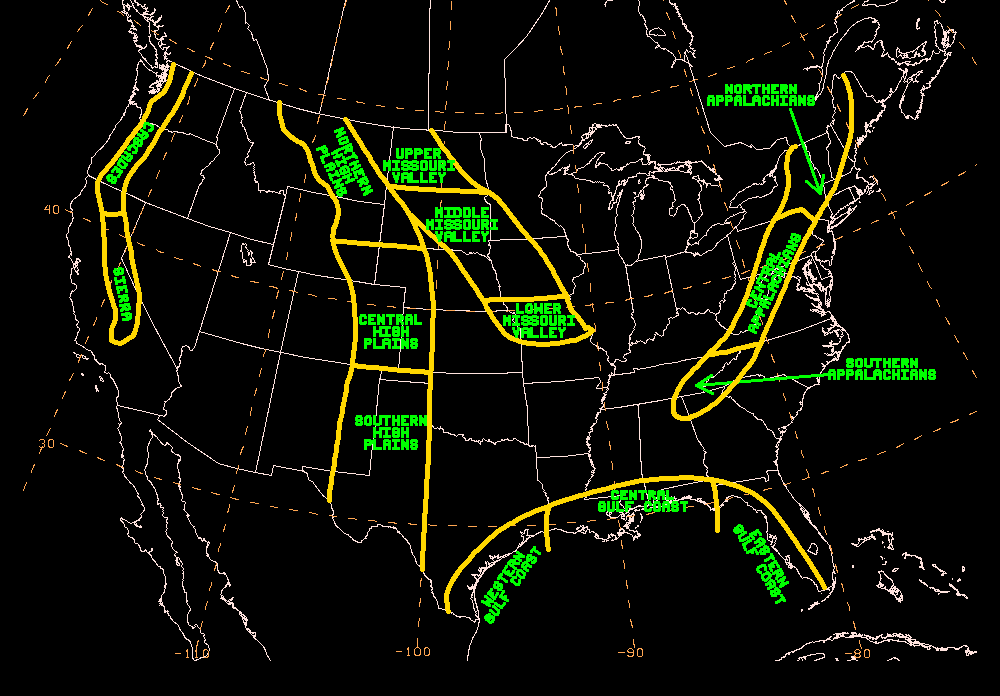
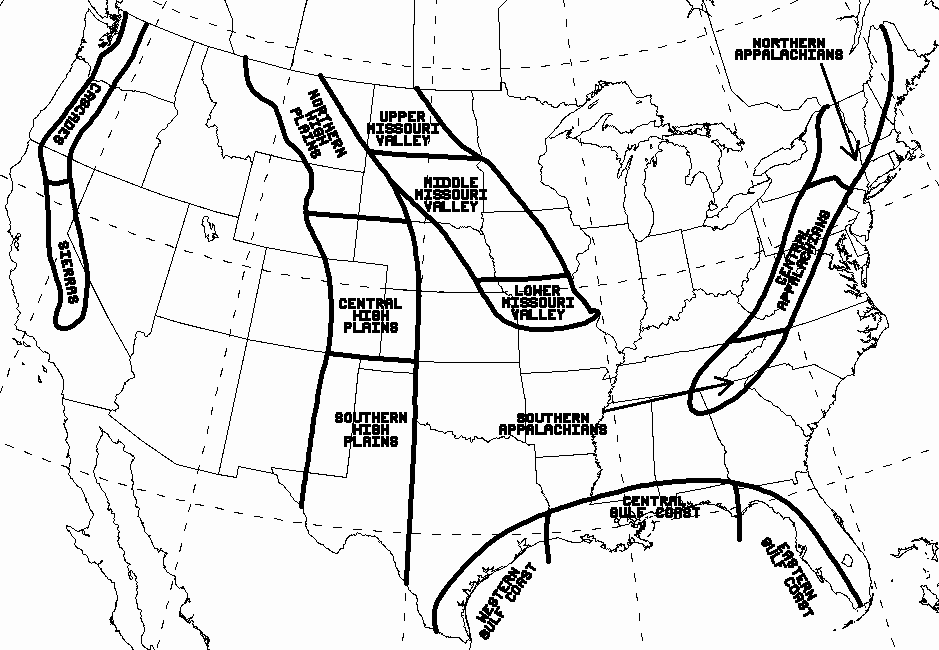
Geographic Boundaries -  Map 1: Color  Black/White       Map 2: Color  Black/White


Probabilistic Heavy Snow and Icing Discussion
NWS Weather Prediction Center College Park MD
216 AM EST Tue Feb 10 2026

Valid 12Z Tue Feb 10 2026 - 12Z Fri Feb 13 2026


...Sierra Nevada to the Central Rockies...
Days 1-3...

Mid-level low over the Pacific will gradually pivot eastward
towards northern CA through Wednesday, lingering across the state
as it slowly fills. Immediately downstream of this feature, a
subtropical jet streak will intensify, especially late this evening
into Wednesday morning, reaching towards 150 kts as it pivots over
central CA. This upper jet will provide favorable LFQ diffluence
overlapping the most significant height falls for pronounced
synoptic ascent, while additionally transporting Pacific moisture
onshore CA before spreading into the Great Basin and Central
Rockies. The evolution of this synoptic pattern suggests that SW
flow downstream of the primary trough axis will support prolonged
moisture advection, which is reflected by IVT probabilities from
both the GEFS and ECENS exceeding 90% for 250 kg/m/s for around 24
today into Wednesday. This moisture will be wrung out by the
significant deep layer ascent (aided by upslope flow especially
across the Sierra) to produce heavy snowfall above generally
6000-7000 ft, with the most intense snowfall rates (2+"/hr
according to the WPC prototype snowband tool) occurring across the
Sierra tonight into Wednesday. WPC probabilities across the Sierra
are high (>70%, 2-day totals) for more than 12 inches in the high
SIerra, but widespread 8+ inches is likely (>70%) for the breadth
of the Sierra and into parts of the northern California terrain.

As the system continues eastward and the upper jet strengthens
over the Great Basin to central Rockies, moisture will continue to
funnel from the sub-tropics into the Four Corners region on
southwesterly flow. Snow levels will waver around 6000-7000ft with
modest amounts expected in an area that has seen very little snow
this season. WPC probabilities for at least 8 inches of snow are
>50% above 7000ft or so in UT and 8000ft in WY, highest over the
Uintas and Wind Rivers/Tetons. Snow will linger longest over the
CO Rockies through Thursday as the moisture plume stalls there as a
result of a second shortwave trailing the lead system, maintaining
SW flow through the end of this period. WPC probabilities for at
least 8 inches are high for 8+ inches across much of the highest
terrain of the Colorado Rockies, with a local maximum above 12
inches expected across the Park Range.


...Eastern Great Lakes and Northeast...
Days 1-2...

A clipper-type low will dig southeast from Ontario through New
England today, exiting into the Gulf of Maine late tonight. This
clipper will be driven primarily by a closed, but weakening, mid-
level low tracking atop it, with elongated vorticity to its south
producing additional ascent. As this upper low shifts off New
England, it will interact with an occlusion well off the coast,
helping to rapidly deepen a surface low over the Atlantic. This
synoptic evolution will result in 3 areas of moderate to heavy
snowfall:

1) Pronounced warm-air-advection (WAA) developing south of the
clipper will surge northeast atop a warm front across the Mid-
Atlantic and into the Northeast. This will create an expanding
shield of precipitation, and although some light mixed
rain/snow/freezing rain is expected over the northern Mid-Atlantic,
much of this precipitation should fall as snow across New England
and Upstate New York. The snow that occurs will likely be heavy at
times within a WAA band, likely exceeding 1"/hr (60-90% chance),
with the short temporal duration limiting the total snowfall.
Still, impactful snow is likely this evening and tonight spreading
from west to east.

2) Post-clipper cold-air-advection (CAA) will become impressive in
the wake of the low. This will create increasing lake effect snow
(LES) despite significant ice cover now over the Great Lakes, as
well as intensifying upslope snow into the terrain of the
Adirondacks and Greens. Very dry air beneath the subsidence
inversion will impinge into the DGZ from above during this time, so
that will act to limit snowfall intensity within the upslope
regime, but additional accumulations are likely. LES will also be
somewhat modest, and focused east of Lake Ontario into the Tug Hill
and then southeast towards the Finger Lakes region, as well as far
SW NY east of Lake Erie.

WPC probabilities for 2+ inches of snow are high (>70%) for much
of northern Upstate NY, as well as central/northern New England.
However, the more substantial snowfall is likely in the higher
elevations where WPC probabilities suggest a high risk (>70%) for
at least 4 inches in the Adirondacks, Greens, and Whites, with
locally as much as 8 inches possible. For the LES areas, WPC
probabilities are moderate (50-70%) for least 4 inches. For the
freezing rain, a swath of moderate probabilities (>50%) exists for
0.01+" of ice from the Finger Lakes through the Poconos and into
southern New England and Long Island. Although amounts should be
less than 0.1"

3) Finally, as the surface low deepens rapidly offshore and near
Nova Scotia Wednesday, the guidance continues to suggest a
lingering inverted trough will pivot near the coast of Maine. Where
this occurs, additional ascent will be locally impressive, leading
to the potential for several inches of additional snowfall. These
inverted troughs can sometimes lead to sneaky-heavy snowfall
accumulations, so while WPC probabilities are moderate for 6+
inches (50-70%), locally higher totals are possible as reflected by
significant spread in the WSE plumes along the coast of Maine.

Weiss