Skip Navigation Links weather.gov 
NOAA logo - Click to go to the NOAA homepage National Weather Service   NWS logo - Click to go to the NWS homepage
The Weather Prediction Center


Follow the Weather Prediction Center on Facebook Follow the Weather Prediction Center on X
WPC Home
Analyses and Forecasts
   National High & Low
   WPC Discussions
   Surface Analysis
   Days ½-2½ CONUS
   Days 3-7 CONUS
   Days 4-8 Alaska
   QPF
   PQPF
   Flood Outlook
   Winter Weather
   Storm Summaries
   Heat Index
   Tropical Products
   Daily Weather Map
   GIS Products
Current Watches/
Warnings

Satellite and Radar Imagery
  GOES-East Satellite
  GOES-West Satellite
  National Radar
Product Archive
WPC Verification
   QPF
   Medium Range
   Model Diagnostics
   Event Reviews
   Winter Weather
International Desks
Development and Training
   Development
WPC Overview
   About the WPC
   WPC History
   Other Sites
   FAQs
Meteorological Calculators
Contact Us
   About Our Site
 
USA.gov is the U.S. Government's official web portal to all federal, state, and local government web resources and services.
 
Excessive Rainfall Discussion
 
(Caution: Version displayed is not the latest version. - Issued 0105Z Dec 04, 2025)
 
Version Selection
Versions back from latest:  0   1   2   3   4   5   6   7   8   9   10   11   12   13   14   15   16   17   18   19   20   
 
Abbreviations and acronyms used in this product
 
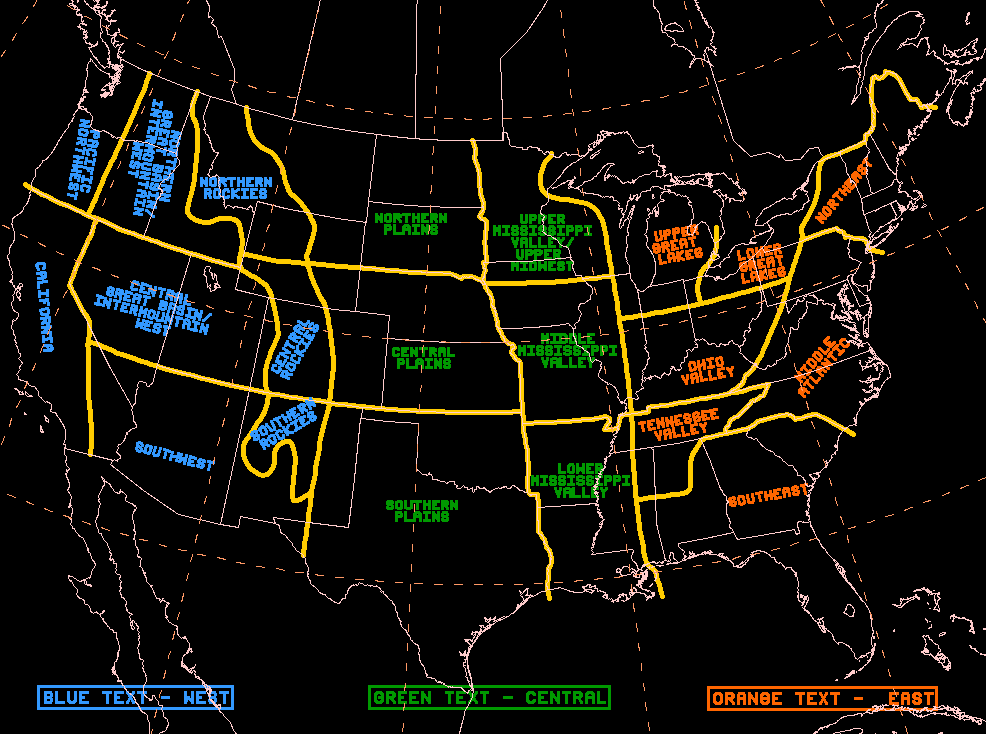
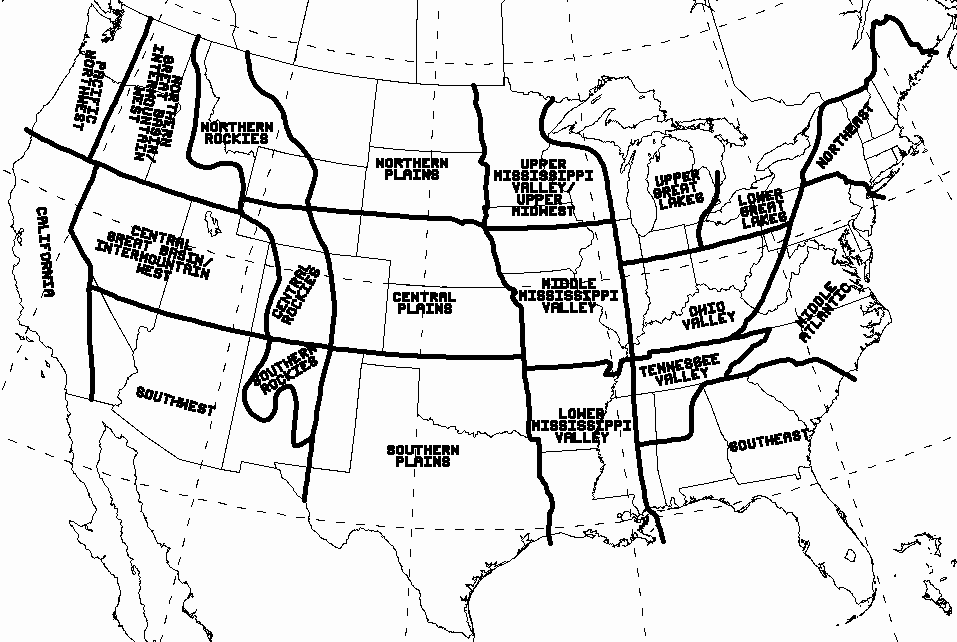
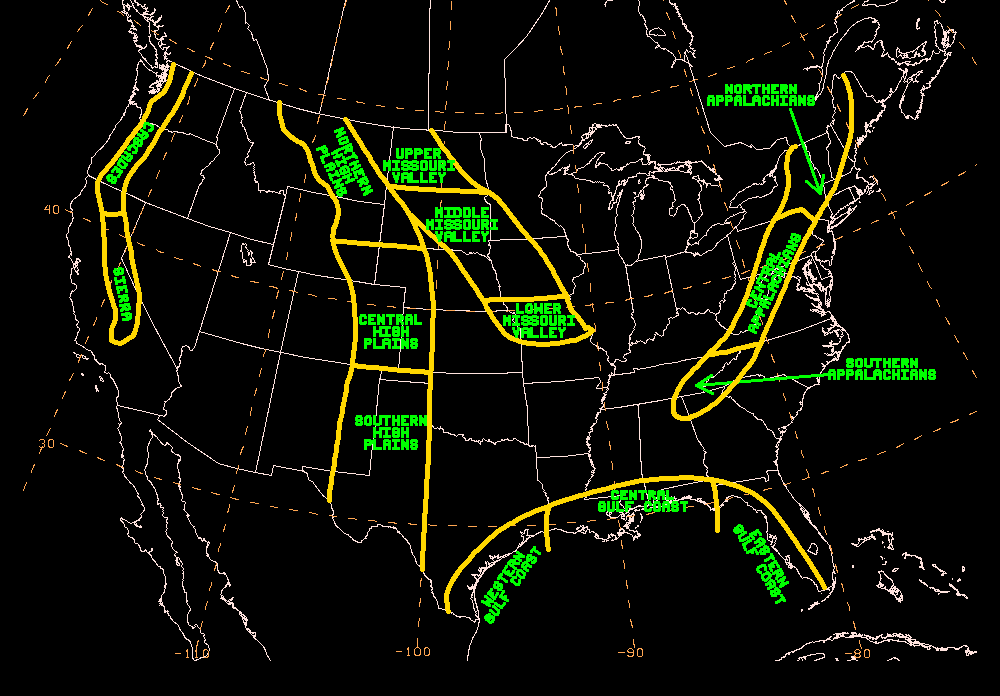
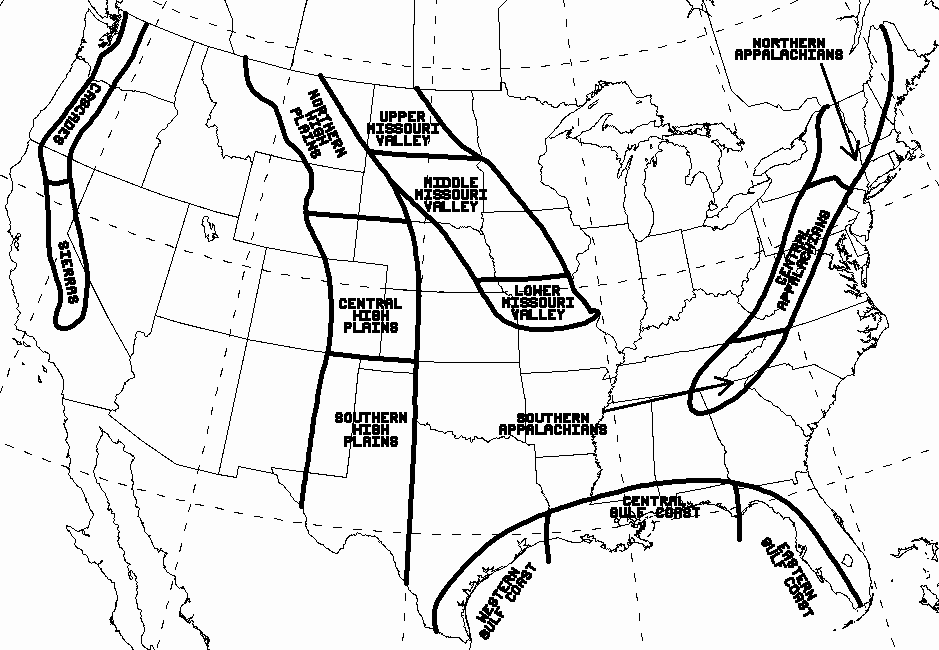
Geographic Boundaries -  Map 1: Color  Black/White       Map 2: Color  Black/White


Excessive Rainfall Discussion
NWS Weather Prediction Center College Park MD
805 PM EST Wed Dec 3 2025

Day 1
Valid 01Z Thu Dec 04 2025 - 12Z Thu Dec 04 2025

...THERE IS A MARGINAL RISK OF EXCESSIVE RAINFALL FOR PORTIONS OF
SOUTHEAST TEXAS AND SOUTHWEST LOUISIANA...

...0100 UTC Update...
Trimmed the Marginal Outlook on both sides (esp. west) based on the
latest guidance trends, including recent HRRR runs and recent (18Z)
HREF rainfall exceedance probabilities. The outlook now extends
from the Upper TX coast into southwest and south-central LA.
Surface-based instability will be non-existent as the upper level
jet streak across North TX into the Ozarks, with the ensuing
right-entrance upper level forcing (northerly low-lvel ageos flow),
keeps the surface warm front offshore. Uptick in 850 mb flow
however along with PWs climbing to around 2" will bring a bubble of
elevated CAPE to the coastal areas between the Upper TX Coast and
south-central LA -- a fairly tight gradient between ~500 J/Kg
inland and ~1500 J/Kg along the coast.

Much of the outlook area is in at least a D1 drought, so to no
surprise the FFGs are quite high (2-3"/hr and 3-4" in 3hrs). Based
on the latest HREF 1/3/6 exceedance probabilities, the outlook area
was pared a bit. Either way, it appears to be a low-end Marginal,
with neighborhood probabilities of flash inundation closer to 5%,
and mostly over urban and flood-prone areas.

Hurley


Day 2
Valid 12Z Thu Dec 04 2025 - 12Z Fri Dec 05 2025

...THERE IS A MARGINAL RISK OF EXCESSIVE RAINFALL FOR THE CENTRAL
GULF COAST...

20Z Update...
Made some small adjustments based on the 12Z HREF/RRFS
probabilities, the 12Z RRFS Mean, and recent deterministic RRFS
runs. With the HREF/RRFS guidance showing the heaviest amounts
remaining more confined to the coast, pulled the Marginal Risk a
little bit further south and west with this update. While the
footprint for heavy amounts may not be as broad, the previously
noted HREF and RRFS guidance continue to indicate heavy amounts (3+
inches) are likely within the highlighted area, with the greatest
threat centered along the southwest Louisiana coast.

Pereira

Previous Discussion...
Upglide/warm-advective elevated convective activity should be
ongoing start of the forecast period (04.12z) across the central
Gulf coast. Steering flow will continue to flatten within fairly
unidirectional west-southwesterly deep layer flow. Right entrance
ascent to 150-170kt jet centered over the Ohio Valley will keep
isentropic moisture flux across the surface front that will
oriented along and south of the coast. A weak mid-level shortwave
will slide from west to east along the southern periphery of the
jet streak maintaining 20-25kt of west-southwesterly 850mb flow
which given 1.75-2" total PWats and modestly unstable ribbon (up to
1000 J/kg) and should maintain the elevated convective
development. Internal training of back-building convective elements
should be the greatest potential for higher rainfall totals across
the Bayous of south-central LA. A slow eastward propagation of the
SSW- NNE oriented line will occur with the translation of the flat
shortwave energy and potentially expand into coastal MS/AL and
perhaps as far as western FL Panhandle by the end of the forecast
period.

There remains some north/south spread in placement of heaviest
rainfall cores/training corridor. The GFS continues a traditional
northward bias along with the NAM relative to the ECMWF and other
global guidance; with some suggestion of overall totals in excess
of 5" in spots. Hi-Res CAMs generally trend toward the southern
solutions with heaviest rainfall along and south of I-10, which
appears more plausible given the overall flow orientation (unstable
air upstream over the waters). Still, there is some solid
suggestion of rainfall rates/totals and environmental conditions
that may warrant an upgrade to a Slight Risk, however, the split in
placement and wider overall total rainfall total spread continues
to be too great to delineate one at this time, but will continue to
evaluate with future updates. As such, the broad Marginal from
Galveston Bay to the Pensacola area of FL remains, though have
broadened it slightly northward to account for the latitudinal
variance.

Gallina


Day 3
Valid 12Z Fri Dec 05 2025 - 12Z Sat Dec 06 2025

...THERE IS A MARGINAL RISK OF EXCESSIVE RAINFALL FOR THE CENTRAL
GULF COAST THROUGH CENTRAL GEORGIA...

20Z Update...
Made only minor adjustments based on the 12Z guidance.

Pereira

Previous discussion...
The deep layer unidirectional west-southwesterly flow regime will
remain in place for the day 3 period as well. The subtle, flat mid-
level shortwave feature will be translating quickly across the
South, through the Carolinas and offshore. The connection to the
western Gulf moisture pool/theta-E source will continue to further
narrow and stretch through an elongated isentropic ascent plane in
the wake of the wave draped across SC, central GA toward the
central Gulf coast. By this time period, the ascent across the
front will be fairly oblique and lapse rates will have moderated
toward limited elevated MUCAPE below 500 J/kg...becoming more of an
Atmospheric River with prolonged moderate rates with 24hr totals
of 1-2" across the length of the stream with scattered localized
maxima of 2-3". To be expected, much like the day 2 period, there
remains a latitudinal spread to the placement of the AR stream and
the width of the inherited Marginal Risk reflects this. However, at
this point, FFG exceedance will be more likely in the longer
duration of 6, 12 and 24hr exceedance, with any flash flooding
potential most likely upstream across LA/S AL, where multiple days
of rainfall should saturate the upper soil profiles and FFG values
may be much lower than currently analyzed.

Gallina


Day 1 threat area: www.wpc.ncep.noaa.gov/qpf/94epoints.txt
Day 2 threat area: www.wpc.ncep.noaa.gov/qpf/98epoints.txt
Day 3 threat area: www.wpc.ncep.noaa.gov/qpf/99epoints.txt