Probabilistic Heavy Snow and Icing Discussion
NWS Weather Prediction Center College Park MD
150 PM EST Wed Feb 11 2026
Valid 00Z Thu Feb 12 2026 - 00Z Sun Feb 15 2026
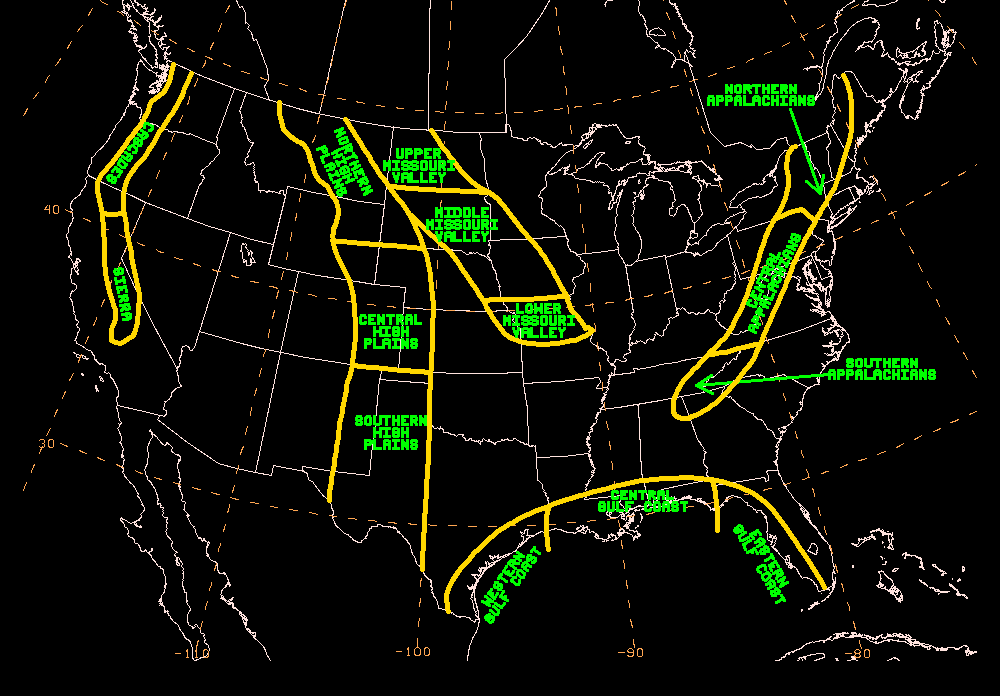
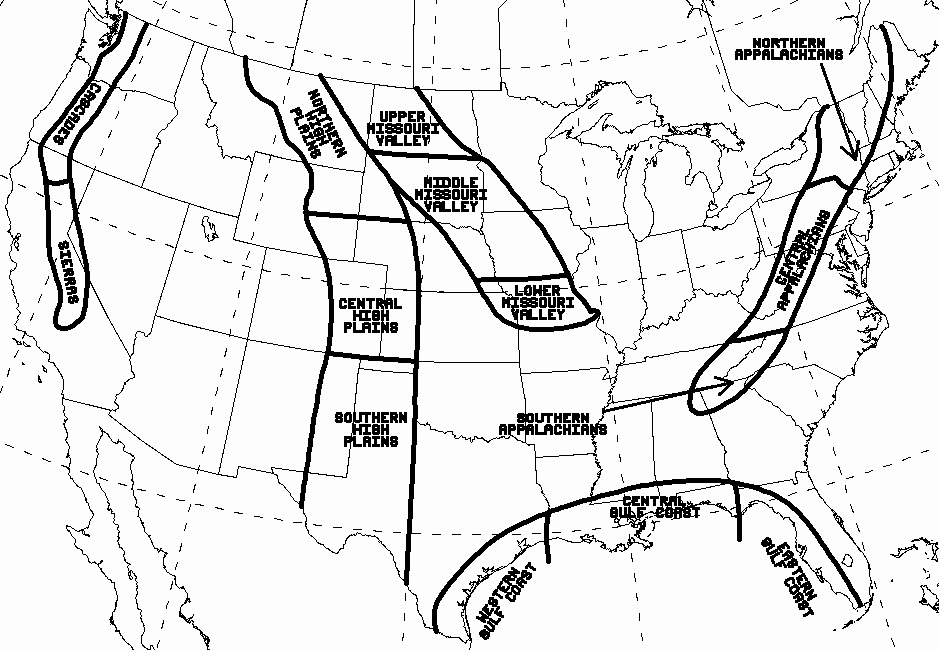
...Eastern Great Lakes & Central Appalachians...
Day 1...
Strong clipper system has exited into the eastern Atlantic and set
up a CAA regime through tonight with modest northwesterly flow and
850 mb temperatures as low as -15C. This will lead to continued
lake-enhanced/upslope snowfall into the favorable terrain from the
central Appalachians through the eastern Great Lakes and northern
New England ranges. However, this period of light to moderate snow
will be short-lived as high pressure builds in over the Mid-
Atlantic on Friday and the next weak clipper approaches New England
Friday night. WPC probabilities are low (<20%) for most regions
outside of the Laurel Highlands of southwest PA and areas downwind
of Lake Ontario.
...Sierra Nevada to the Central/Southern Rockies...
Days 1-2...
A closed mid-level low positioned along the coast of northern CA
will generally fill in place as the accompanying longwave trough
elongates back to the southwest as secondary vorticity energy
rotates through the base ot approach southern CA and Baja by Friday
morning. This stalled evolution will result in a resurgence of an
upper level jet streak to sharpen downstream of this trough axis,
and while the secondary jet streak tonight into Thursday won't be
as powerful as the lead jet, it will maintain moisture advection
and broad LFQ diffluent ascent from CA into the Central Rockies.
The overlap of this jet streak with broad but persistent SW mid-
level flow also downstream of the primary trough axis will surge
moisture eastward as far as CO as reflected by NAEFS IVT
percentiles surging to above the 99th percentile in CO, with
prolonged anomalies above the 90th percentile back into the Great
Basin.
This plume of moisture will be primarily shed eastward within a WAA
plume, so snow levels will be generally 6000-7000 ft, lowering
slowly as the trough axis pivots eastward, but this will likely be
accompanied by rapid drying and a resulting cutoff of
precipitation. For this reason, the heaviest snowfall accumulations
are likely to be above 7000 ft (as high as 8000 ft in CO), with a
wane in precipitation expected as snow levels fall. WPC
probabilities D1 are high for at least 6 inches of snow in the
Uintas/Wasatch, the Tetons/Wind Rivers, and parts of the CO Rockies
including the Park Range. D2 probabilities compress and fall
rapidly, leading to just residual elevated probabilities above 20%
for 4+ inches in the CO Rockies. Most probabilities drop off below
20% after 00z tonight in Sierra given a majority of the
precipitation occurs prior to 00z tonight.
...Southern Rockies...
Day 3...
The same secondary shortwave responsible for elongating the trough
over CA/Great Basin D2 will shed eastward Friday morning, moving
across southern CA/Baja Norte before closing off once again near
the Four Corners Friday evening. This evolution will promote
downstream ascent through impressive height falls paired with
modest jet streak amplification, leading to widespread deep layer
lift spreading into the Four Corners and southern Rockies Friday
into Saturday. The antecedent thermal structure will be modest for
snowfall (snow levels 8000-9000 ft), but increasing ascent within
a moistening column will expand precipitation and allow for snow,
which could be heavy, especially in the higher terrain of the
Sangre de Cristos, White Mountains, and San Juans, with some
dynamic cooling of the column possible later D3 as some deformation
develops across northern NM. Still a lot of uncertainty in the
exact evolution, but at this time WPC probabilities indicate a
moderate risk (40-70% chance) for at least 4 inches in the higher
terrain.
...Washington Cascades...
Day 3...
By late day 2 into day 3, the next upper trough to approach the
West Coast from the Gulf of Alaska orients a weak axis of IVT (<300
kg/m/s) into the Cascades. Snow levels start out rather low and are
forecast to drop below 2,000 ft and below pass level. However,
precipitation amounts appear light enough to avoid heavier snow
amounts. Still, WPC probabilities for at least 4 inches of snow are
high (>70%) in the Cascades above about 4,000 feet. Probabilities
for at least 4 inches of snow for Stevens and Snoqualmie passes
are between 20-40%.
The probability of significant icing across the CONUS is less than
10 percent.
Snell/Weiss