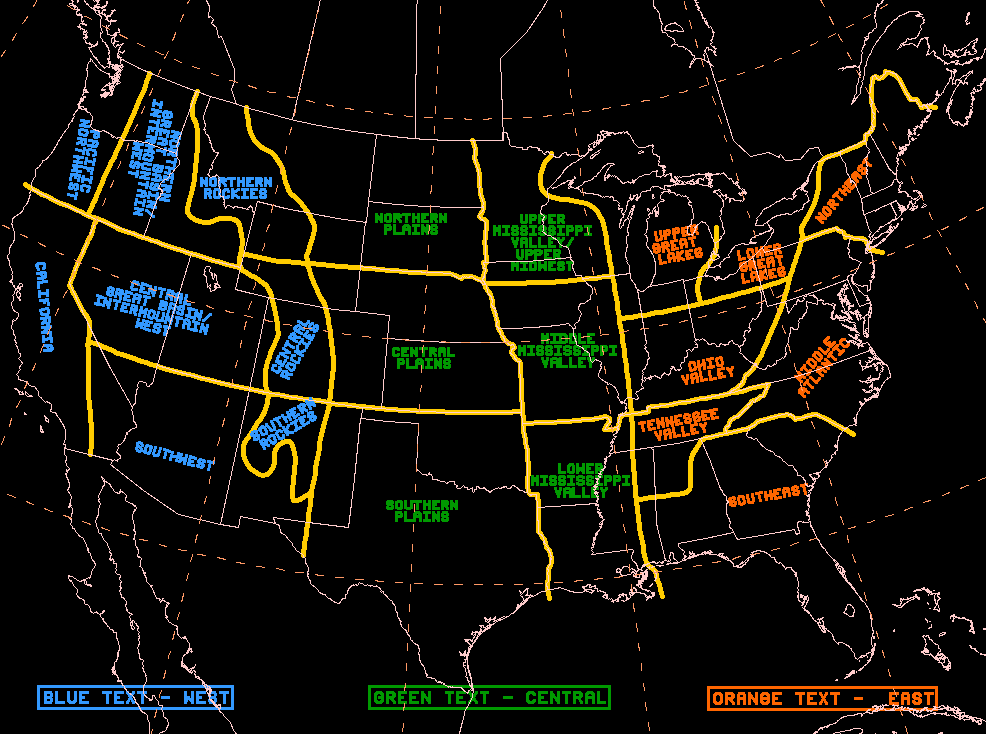
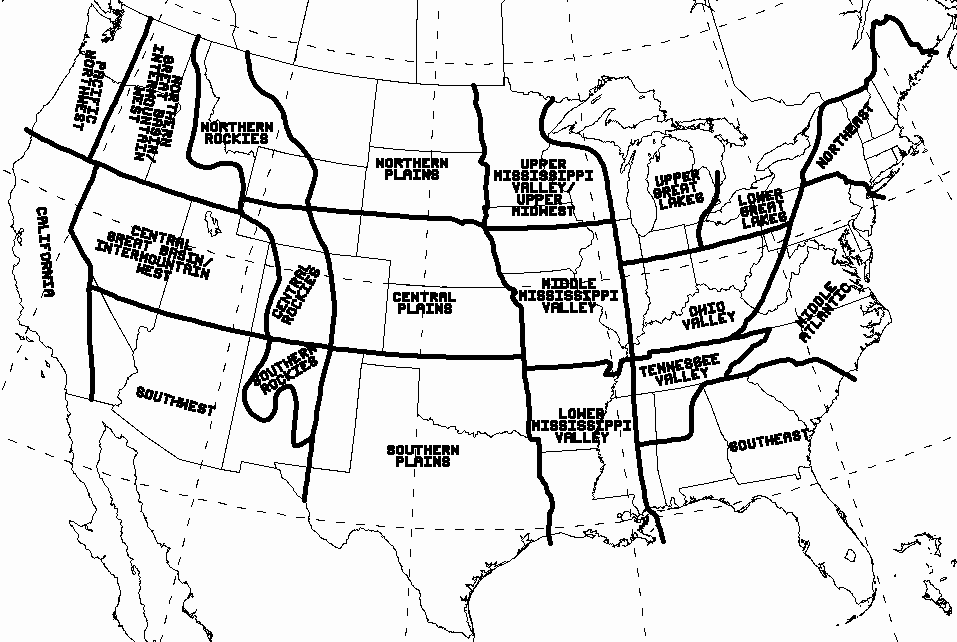
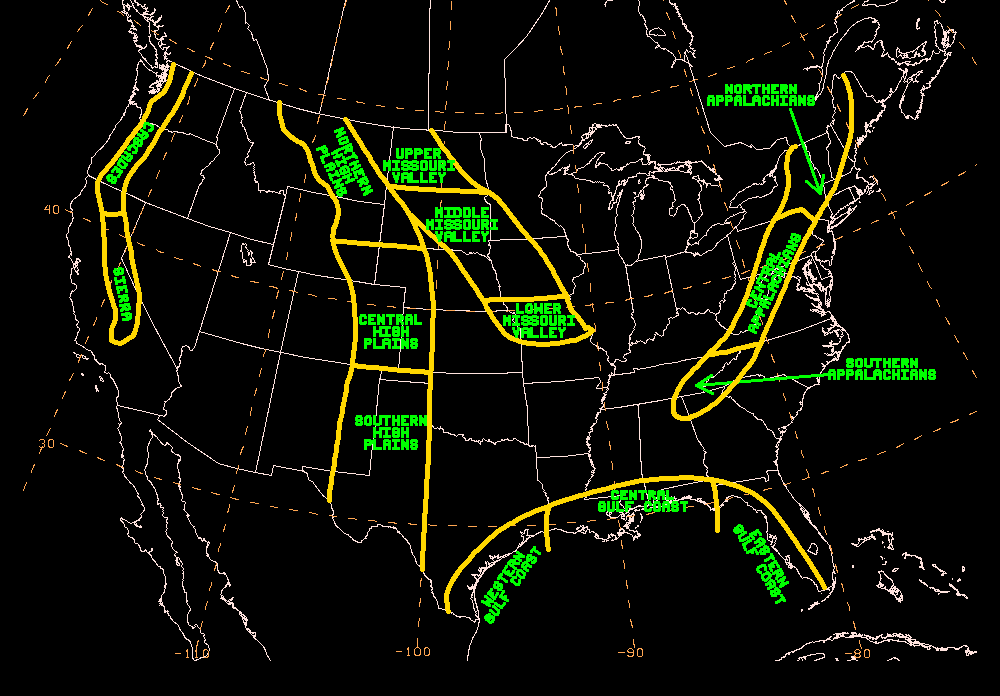
Excessive Rainfall Discussion
NWS Weather Prediction Center College Park MD
1151 AM EDT Thu Jul 25 2024

Day 1
Valid 16Z Thu Jul 25 2024 - 12Z Fri Jul 26 2024

...THERE IS A MODERATE RISK FOR EXCESSIVE RAINFALL FOR THE MIDDLE
AND UPPER TEXAS COAST THROUGH SOUTHWEST LOUISIANA...

...16Z Update...

Generally only modest adjustments were made to the risk areas with
today's midday update. The Moderate Risk remains largely the same,
covering Beauregard, Calcasieu, and Cameron Parishes, then
extending well southwest along the Upper and Middle Texas Coasts to
the ongoing flash flooding on Padre Island. This is a very small
southwestward extension of the Moderate to Padre Island given the
impressive totals seen there over the past 6 to 12 hours.

Elsewhere, a nearly stationary band on the north side of the
precipitation shield over east-central Texas resulted in a small
extension of the Slight Risk area to cover that rainfall...likely
with a minimum of rainfall between it and the main precip shield
along the coast.

The Marginal Risk area was expanded northwest along the
Mississippi River along the full IL/MO border to cover the isolated
convection over western Illinois that is likely to drift south
through the day. Not surprisingly, CAMs are struggling with it, but
given the persistent signal that they'll persist in many of the
models as well as the history of isolated flash flooding, the
Marginal was added.

Very few changes to the Slight in the Southeast, with just a few
nudges based on the latest 12Z data.

In similar fashion, no changes were needed to the large Marginal
across the Intermountain West, as it covers all the potential FFG
exceedance areas based on the 06Z HREF.

Wegman

...Previous Discussion...

...Texas and Louisiana...

Current upper air and surface analysis across South TX indicates
the development of a weak surface reflection with a closed 85H
(850mb) low present as of the latest observations. This will play
a significant role in the upstream convective potential through the
period, especially along the immediate TX coast from CRP up
through the Southwest coast of LA. There's a near unanimous
consensus on the latest 00z CAMs of a targeted area of significant
rainfall within the region spanning from Matagorda Bay up to just
south of Galveston during the first half of the forecast period.
850mb low across South TX will slowly migrate to the northeast
with a focused LLJ on the eastern flank of the circulation. The
enhanced jet and increasing low level convergence under the
surface and 850mb low(s) will generate a skinny axis of heavy
rainfall with embedded convection given marginally sufficient
MUCAPE located near the coast. 00z sounding out of KCRP was
indicative of deep tropical moisture entrenched within the column
as PWATs nestled just under 2.4", a solid 3 deviations above normal
and within the 99th percentile climatologically, just falling
short of the daily maximum of 2.42". Regardless of a record or not,
the environment is indicative of a moist, tropical airmass that
will exude efficient warm rain processes through any convective
development and the evolving pattern this evening through the
morning is one that will very likely promote intense rainfall
locally within the confines of the surface and closed 850mb
reflections. This setup will slowly migrate to the northeast during
the morning, but the setup for later this afternoon and the
following evening still has the "jury out" on exactly how the 850mb
low behaves.

As of now, the mean QPF output via the HREF and associated
ensembles are depicting a narrow axis of significant rainfall
totals extending from just northeast of Port Aransas up through
Galveston Bay and eventually hitting the Upper Texas coast near the
Sabine River, the same place that was just impacted recently from
significant rainfall yesterday. The probability fields for >3" of
rain are pronounced within that corridor, but the upper quartile
outcomes and associated neighborhood probabilities for at least 5"
(50-80%) and 8" (20-40%) are much higher further south along the
Middle TX coast with the bullseye situated around Port Lavaca up
through Matagorda with the former being the focal point for the
heaviest rainfall as of the latest model output. Further away from
the coast remains a question on the inland extent of the heavy rain
as the QPF from many of the CAMs and even some global deterministic
are all shying away from a larger protrusion inland with the focus
still remaining primarily at the coast. So much of this is
contingent on the behavior of the 850mb low as a longer
maintenance of the low across the coast would likely enhance a
secondary push of convection inland by nightfall thanks to a
redevelopment of the LLJ aimed orthogonal to the coast after 00z
this evening. Models that do have this outcome are more bullish in
a larger impact footprint to the north as the low drifts that
direction and allows for a greater inland focus to arise as we step
into the back end of the forecast period. These solutions also
give credence to higher potential impacts for greater Houston, so
that will be something to monitor in time where there could be
adjustments to the current MDT risk forecast.

For now, the main threat is tied closer to the coastal areas with
the previous MDT risk generally maintained by expanded to the south
to the northeast of CRP, mainly from Matagorda Bay on northeast.
The northeastern extent of the MDT was trimmed back across LA with
guidance becoming less enthusiastic with the push of deeper
moisture inland near Lake Charles and points north and maintaining
a more confined coastal heavy rain threat, similar to where the
impacts were felt this past forecast period.

...Southeast into the Southern Mid Atlantic...

An intensifying upper jet across the Ohio Valley will extend into
the Northeastern U.S with a strengthening core upwards of 130kts
reflecting some fairly significant large scale ascent within the
right entrance region (RER) of the jet. At the surface, a cold
front will translate east and southeastward with progression
through the Mid Atlantic and the Southern Ohio Valley through the
period leading to some modest surface convergence along the front
with scattered to widespread convection out ahead of the boundary
thanks to the present large scale ascent from the aforementioned
jet. Sufficient low-level buoyancy located across Southern VA
through the Carolinas into the Deep South will promote an
opportunity of heavy thunderstorms with the highest probability
located over the Carolinas into Eastern Ga due to the presence of a
quasi-stationary front still bisecting the area. This will become
a focal point for low-level convergence and will provide an anchor
for storms to develop and slowly drift within the confines of the
boundary. Rainfall rates of 1-2"/hr will be most common in any
storm development, but a max of 3"/hr is still plausible given the
low probabilistic output of 10-20% over a large portion of the
Carolinas into far Eastern GA for those 3"/hr potentials. Mean QPF
output via the HREF was solidly between 1-2" spatially with the
individual CAMs output signaling some much higher local totals that
could exceed 4" in some cases, a much greater threat for flash
flooding potential.

Considering the incessant nature of the pattern the past week with
copious heavy rainfall episodes contributing to flash flooding
across the Carolinas, a SLGT risk from previous forecast was
maintained with a small shift on the western extent of the risk
area where the probabilities dropped off significantly for the
threat of flooding rainfall, carrying the signal closer to the
SC/GA line than previous forecasts.

...West...

Monsoonal convection will encompass much of the Southwest U.S with
primary coverage in the Great Basin as the mid-level ridge pattern
shifts focus to the west of the Four Corners. Modest moisture
anomalies and relatively formidable instability across much of the
region will allow for scattered thunderstorms with isolated heavy
rain cores that could spell issues if they fall along complex
terrain, burn scars, urban footprints, and slot canyons. More
widespread convective coverage is forecast across UT/Southern
ID/Western WY as a result leading to an expansion of flash flood
concerns within those areas. Neighborhood probabilities for the
higher convective totals >1" are still most prominent across AZ
with the focus areas being over the Mogollon Rim down through the
Southern terrain near the border where the probs are running
between 60-80% for the threat of at least 1". Secondary maxima are
popping up across the Inner Mountains west within Utah and Western
Colorado, but the threat is a little more subdued due to the lower
instability outputs that favor further south under the 500mb ridge.
Still, the moisture anomalies are forecasted to be best to the
north, so there could be some sneaky prospects for locally higher
impacts from convection, especially within the terrain and
adjacent valleys. The MRGL risk was generally maintained from
previous forecast but did expand the risk slightly on the northern
periphery to account for the moisture anomalies and accompanying
forecast instability across those northern zones.

Kleebauer


Day 2
Valid 12Z Fri Jul 26 2024 - 12Z Sat Jul 27 2024

...THERE IS A SLIGHT RISK FOR EXCESSIVE RAINFALL FOR PORTIONS OF
THE CAROLINAS...

...Carolinas...

The cold front from the previous period will finally make progress
off the eastern seaboard across the northern half of NC while
making slow progress to the south through the rest of NC/SC region.
Scattered thunderstorms within the persistent deep moist and
unstable environment will allow for a period of heavy rain
potential, especially along and ahead of the cold front as it
migrates southward. The heaviest rain will align over Eastern NC
into the South Carolina Low Country, areas where FFGs are a bit
higher and potentially more difficult to flood. Previous rainfall
has lowered the FFG indices, especially as you work from Columbia,
SC to points northeast which plays a role in the current SLGT risk
maintenance. Ensemble QPF output is currently between 1-2" across
Southeast NC, including the Wilmington area extending down through
the Low Country and coastal sections of SC. Individual
deterministic output is as expected with some local maxima around
4" within any particular global member leading to ensemble bias
corrected means closer to 2-2.25" over the hardest hit areas. Did
trim back on the northern extent of the previous SLGT with
maintenance further south and southeast across central and eastern
SC up through Southeast NC where the front will slow in forward
progression and become a focal point for Friday afternoon
convection. Best threat for flash flooding will likely occur over
more urbanized zones due to the sandier soils present in the
confines of the current risk area which lead to the continuity,
and not expecting any upgrades in the current setup.

...Southwest through the Inner Mountain West...

Scattered thunderstorms within a favorable moist axis will linger
through the Southwestern U.S with the northern half of the
convective threat shifting further inland into the Interior before
hitting the proverbial wall at the Central Rockies. Any storm
within the period could exude heavy rainfall with rates generally
topping at 1"/hr, an intensity that could easily cause issues
within the complex terrain out west. The increased moisture
advection back over NM will also open the door for more convective
threats within the remnant burn scars in place over the Sangre de
Cristos, so the MRGL risk was promptly positioned to cover for the
threat. General rainfall maxima is expected to be between 1-2" but
a small chance for locally higher remains, especially from any
cells that get anchored to the terrain. The previous MRGL risk was
kept to general continuity, but did pull the MRGL risk a little
further west into NV due to some linger convective potential from a
trailing shortwave migrating through the region during peak diurnal
instability, aligned with a further west QPF footprint as of the
latest NBM and ensemble bias corrected outputs.

...East Texas through the Lower Mississippi Valley...

Remnant mid-level energy will linger across Eastern TX into the
Lower Mississippi Valley within a persistent anomalous moisture
presence situated over the region. Sufficient buoyancy and
attendant large scale forcing will likely generate periods of
scattered convection capable of producing locally heavy rainfall
over the aforementioned areas. There are some indications that a
much more defined 500mb low will develop over the Southern Plains
which would increase the general forcing pattern allowing for a
more robust convective initiation over the eastern flank of the
mid-level circulation. This was noted via some of the 00z global
deterministic with the ECMWF being the most aggressive with the
solution. There are some hints of the threat becoming more
pronounced across East TX into parts of LA/AR given the recent GFS
Graphcast and ECMWF AIFS ML output, so a targeted upgrade may occur
over the above areas if the consensus grows and remains stable
in the upcoming model iterations. For now, a MRGL was maintained
from previous forecast.

Kleebauer


Day 3
Valid 12Z Sat Jul 27 2024 - 12Z Sun Jul 28 2024

...THERE IS A MARGINAL RISK FOR EXCESSIVE RAINFALL ACROSS MUCH OF
THE SOUTHEAST, MID MISSISSIPPI VALLEY, SOUTH AND EAST TEXAS,
NORTHERN PLAINS AND UPPER MIDWEST, ALONG WITH PORTIONS OF THE
SOUTHWEST AND INNER MOUNTAIN WEST...

...Texas through the Mid Mississippi Valley...

Pending the evolution of the 500mb pattern across the Southern
Plains, the same areas will be subject to a continuation of the
active convective pattern across South and East TX, spreading
northeast into the Mid Mississippi Valley as indicated by a few
global deterministic. Ensemble means are relatively benign in terms
of areal coverage of at least 1" with the highest located along the
TX coast due to potential surface trough refocusing over the
Western Gulf. A deep moist environment with prevalent mid-level
synoptics would certainly support at least the chance of heavy
rainfall and accompanying flash flooding, so the risk area from
previous forecast was relatively unchanged. There could be a future
upgrade if the mid-level pattern progression supports a more
dynamic setup away from the coast, and/or the coastal plains of TX
see an increasing heavy rain footprint that would call for an
upgrade. Until then, the consensus was not clear enough to warrant
an upgrade, so maintained continuity.

...Southeast...

Scattered thunderstorms capable of locally heavy rainfall will be
possible during peak diurnal convection on Saturday. The moisture
anomalies continue to favor a primed environment for a few
thunderstorms creating some isolated flash flood concerns with
totals generally around 1-2" with a chance for 3+ inches in the
strongest cells. This setup is on the lower end of the MRGL
threshold, so some changes are possible in future updates. For now,
with the signature present in a deeper moisture field, the previous
risk forecast was maintained.

...Upper Midwest...

A digging shortwave trough will enter the northern tier of the
Central U.S with increasing large scale ascent over a relatively
sufficient moist axis and accompanying surface based instability.
The threat for locally heavy rainfall will be highest during the
late afternoon and evening on Saturday with some isolated higher
totals that could enhance local flash flood concerns. The previous
forecast was maintained for continuity as the ensemble QPF output
remains generally unchanged from previous forecast issuance.

...West...

Scattered convection across the Rockies down into Southeast AZ will
continue for another period as the presence of sufficient deep
layer moisture extending from the International Border up near the
Northern Rockies will aid in potential heavier convective cores
that could cause issues within the complex terrain aligned over the
outlined area. The area across NM and a few spots over the Central
Rockies will be the highest threat for flash flooding due to burn
scar remnants creating a higher probability for hydrophobic based
run off within the confines of the area. Targeted SLGT risks will
be possible in the future, but the ensemble mean and scattered
nature of convection is too much of a factor to account for a
higher risk area. General continuity was maintained outside some
minor expansions over the northern section of the risk.

Kleebauer

Day 1 threat area: www.wpc.ncep.noaa.gov/qpf/94epoints.txt
Day 2 threat area: www.wpc.ncep.noaa.gov/qpf/98epoints.txt
Day 3 threat area: www.wpc.ncep.noaa.gov/qpf/99epoints.txt
 weather.gov