Skip Navigation Links weather.gov 
NOAA logo - Click to go to the NOAA homepage National Weather Service   NWS logo - Click to go to the NWS homepage
The Weather Prediction Center


Follow the Weather Prediction Center on Facebook Follow the Weather Prediction Center on X
WPC Home
Analyses and Forecasts
   National High & Low
   WPC Discussions
   Surface Analysis
   Days ½-2½ CONUS
   Days 3-7 CONUS
   Days 4-8 Alaska
   QPF
   PQPF
   Flood Outlook
   Winter Weather
   Storm Summaries
   Heat Index
   Tropical Products
   Daily Weather Map
   GIS Products
Current Watches/
Warnings

Satellite and Radar Imagery
  GOES-East Satellite
  GOES-West Satellite
  National Radar
Product Archive
WPC Verification
   QPF
   Medium Range
   Model Diagnostics
   Event Reviews
   Winter Weather
International Desks
Development and Training
   Development
WPC Overview
   About the WPC
   WPC History
   Other Sites
   FAQs
Meteorological Calculators
Contact Us
   About Our Site
 
USA.gov is the U.S. Government's official web portal to all federal, state, and local government web resources and services.
 
Winter Weather Forecast Discussion
 
(Caution: Version displayed is not the latest version. - Issued 1945Z Feb 10, 2026)
 
Version Selection
Versions back from latest:  0   1   2   3   4   5   6   7   8   9   10   
 
Abbreviations and acronyms used in this product
 
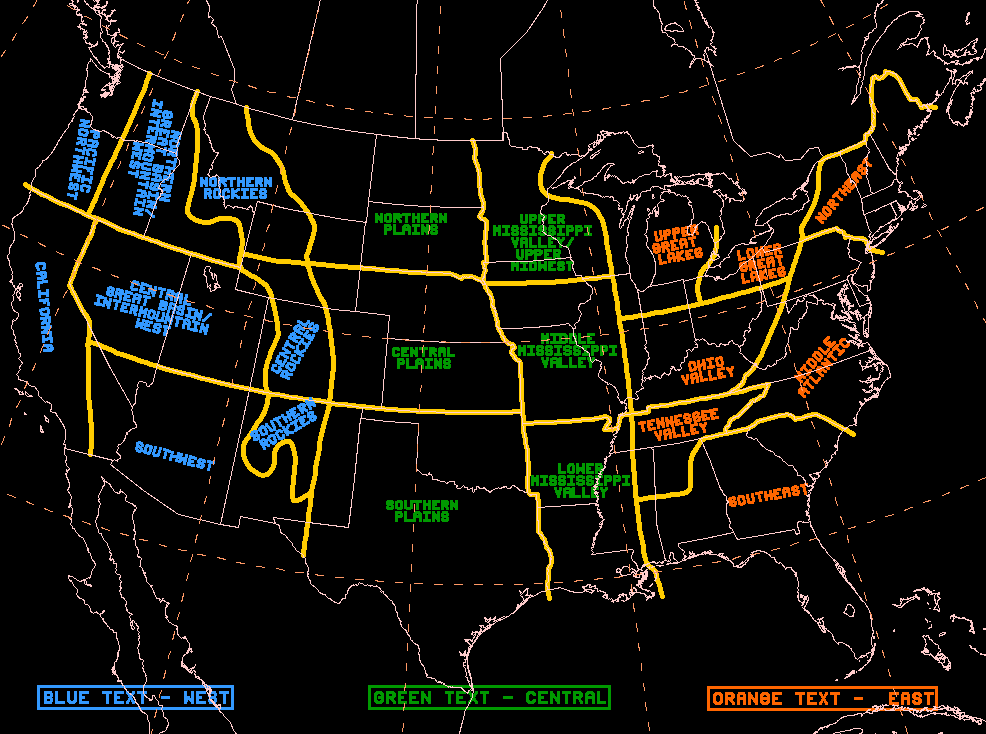
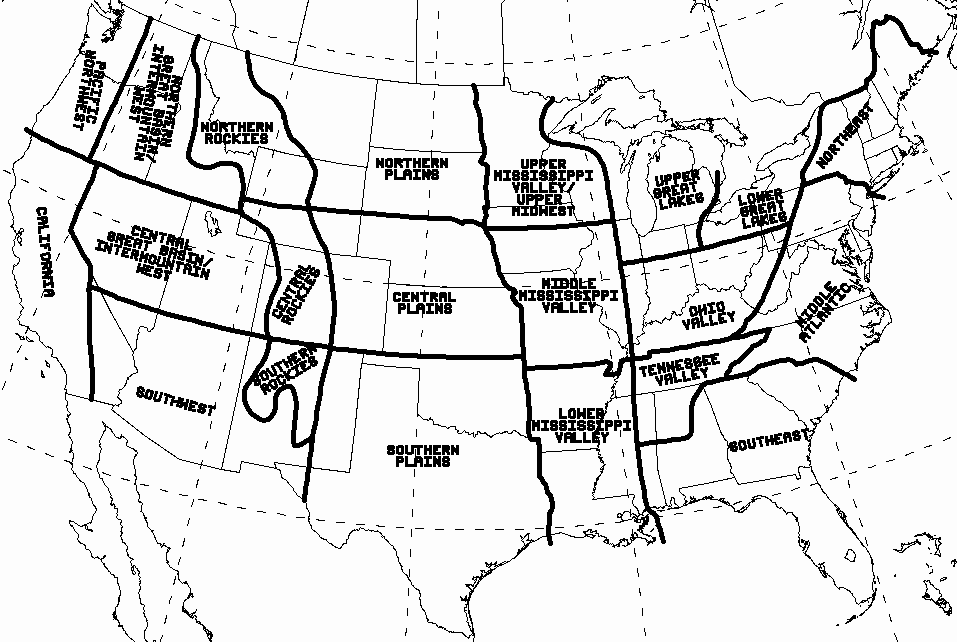
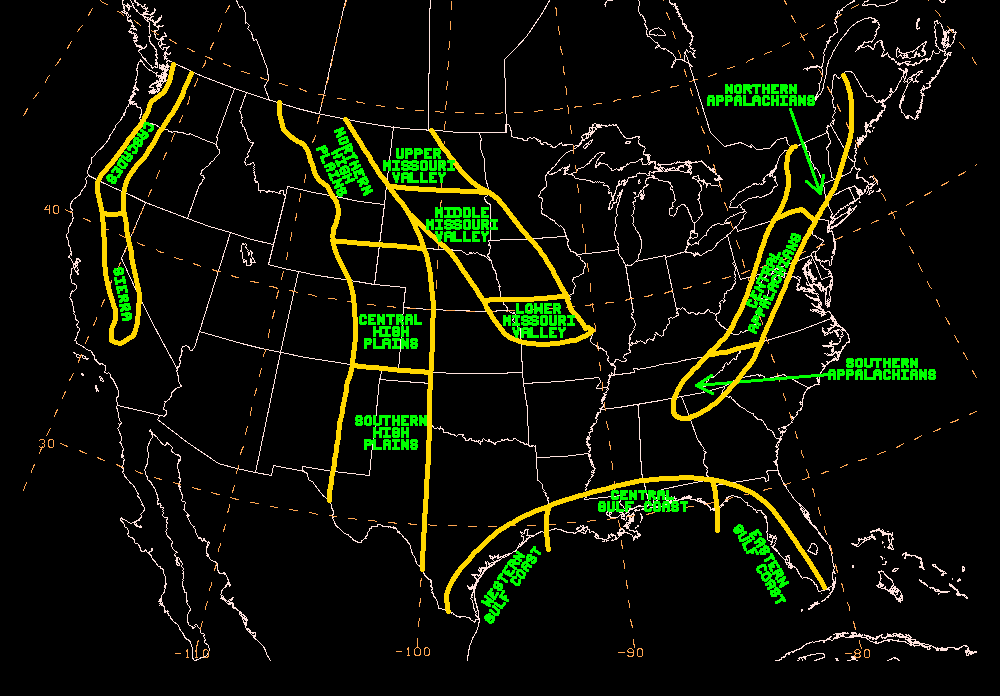
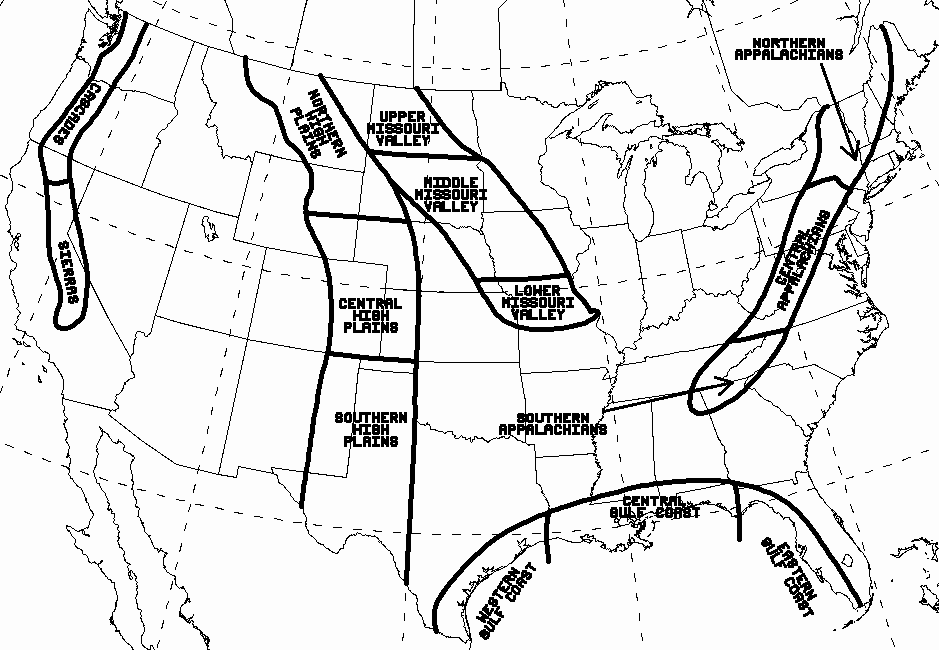
Geographic Boundaries -  Map 1: Color  Black/White       Map 2: Color  Black/White


Probabilistic Heavy Snow and Icing Discussion
NWS Weather Prediction Center College Park MD
245 PM EST Tue Feb 10 2026

Valid 00Z Wed Feb 11 2026 - 00Z Sat Feb 14 2026


...Sierra Nevada to the Central/Southern Rockies...
Days 1-3...

Closed low just west of NorCal will push eastward tonight as a
surface cold front moves toward/into the Sierra. A trailing upper
low to its northwest will take a longer route along its southwest
side and eventually move into the Southwest/northeastern Mexico
late in the forecast period. The trough axis will remain
positively-tilted as the two entities act to slow the overall
progress of the flow resulting in an unsettled period but bounded
by two periods of modest to perhaps heavier precipitation. Moisture
amounts and flux anomalies are modest, but accumulations will be
aided by favorable upslope SW flow. Snow levels will vary between
6000-7000ft over the Sierra and snow rates will likely be >1-2"/hr
at times tonight/early Wednesday per the 12Z CAM guidance. WPC
probabilities for at least 12 inches of snow are >50% above 6500ft
or so. Two-day totals may exceed 2ft in the highest elevations.

Farther downstream, moisture tied back to the subtropics will
continue to increase over the Great Basin to the central Rockies
tonight as the upper jet accelerates over the region and PVA
increases. Snow levels around 6000-7000ft will favor mountain snow
to areas that have seen very little this season. WPC probabilities
for at least 8 inches of snow are >50% above 7000ft or so in UT and
8000ft in WY, highest over the Uintas and Wind Rivers/Tetons, but
with modest totals overall. Snow will linger longest over the CO
Rockies through Thursday as the moisture plume stalls due to the
trailing upper low. WPC probabilities for at least 8 inches of snow
are >70% above 10,000ft or so in CO. By Friday, as that system
finally moves over northeastern Mexico, moisture and height falls
will lead to snow over the southern Rockies (southwestern CO and
northern NM) as well as into AZ (Mogollon Rim/White Mountains).
Amounts will be light except for the highest elevations, generally
above 10,000ft.


...Eastern Great Lakes and Northeast...
Days 1-2...

A strong clipper-type low will move through New England tonight
and stretch out to the Gulf of Maine by tomorrow morning. This
clipper will be driven primarily by a closed, but weakening, mid-
level low tracking atop it, with elongated vorticity to its south
producing additional ascent. The elongated vorticity will favor a
jump in the surface low down the occlusion and into the Gulf of
Maine by 12Z Wed which will then start to rapidly deepen as it
pulls away into Atlantic Canada. The storm will come in three
distinct parts related to winter weather:

1) Pronounced warm-air-advection (WAA) developing south of the
clipper this evening will surge northeastward atop a warm front
across the Mid-Atlantic and into the Northeast. This will create an
expanding shield of precipitation, and although some light mixed
rain/snow/freezing rain is expected over the northern Mid- Atlantic
into the NYC metro area, much of this precipitation should fall as
snow across New England (esp north of I-90) and Upstate New York.
The snow that occurs will likely be heavy at times within a WAA
band, likely exceeding 1"/hr (60-90% chance per the 12Z HREF), with
the short temporal duration limiting the total snowfall. Still,
impactful snow is likely this evening and tonight spreading from
west to east with the highest totals over the Adirondacks and
central/northern New England.

2) Post-clipper cold-air-advection (CAA) will become impressive in
the wake of the low. This will create increasing lake effect snow
(LES) despite significant ice cover now over the Great Lakes, as
well as intensifying upslope snow into the terrain of the
Adirondacks and Greens. Very dry air beneath the subsidence
inversion will impinge into the DGZ from above during this time, so
that will act to limit snowfall intensity within the upslope
regime, but additional accumulations are likely. LES will also be
somewhat modest and multi-banded, focused east of Lake Ontario into
the Tug Hill and then southeast through the Finger Lakes region
into far SW NY east of mostly frozen Lake Erie (likely aided from
Lake Huron and/or Georgian Bay).

WPC probabilities for at least 4 inches of snow are >50% for the
western Adirondacks as well as central/northern New England and
much of Maine, especially outside the lower elevations. For the
higher elevations, WPC probabilities for at least 6 inches of snow
are >50% over the Greens, Whites, and the Central Highlands in
Maine with locally as much as 8 inches possible. For the LES areas
in NY, WPC probabilities are moderate (40-70%) for least 4 inches
with higher local accumulations. For the freezing rain, a swath of
moderate probabilities (40-70%) exists for 0.01+" of ice from the
Finger Lakes/Southern Tier down I-88/81 through the Poconos
eastward along I-80 through northern NJ and into southern New
England and perhaps Long Island. Amounts should be less than 0.10"
but any freezing rain can be hazardous to travel, especially
overnight.

3) Finally, as the surface low deepens rapidly offshore and near
Nova Scotia Wednesday, the guidance continues to suggest a
lingering inverted trough that will pivot near the coast of eastern
Maine. Where this occurs, additional ascent will be locally
impressive, leading to the potential for several inches of
additional snowfall. These inverted troughs can sometimes lead to
sneaky-heavy snowfall accumulations, but WPC probabilities for at
least 8 inches of snow are moderate (40-70%) around Eastport.
Locally higher totals are possible as reflected in some rather
robust 12Z CAM members along the coast of Maine.

The probability of significant icing across the CONUS is less than
10 percent.


Fracasso/Weiss