




202610151220261015122026101512
Valid Thu Oct 15, 2026
Valid Fri Oct 16, 2026
Valid Sat Oct 17, 2026

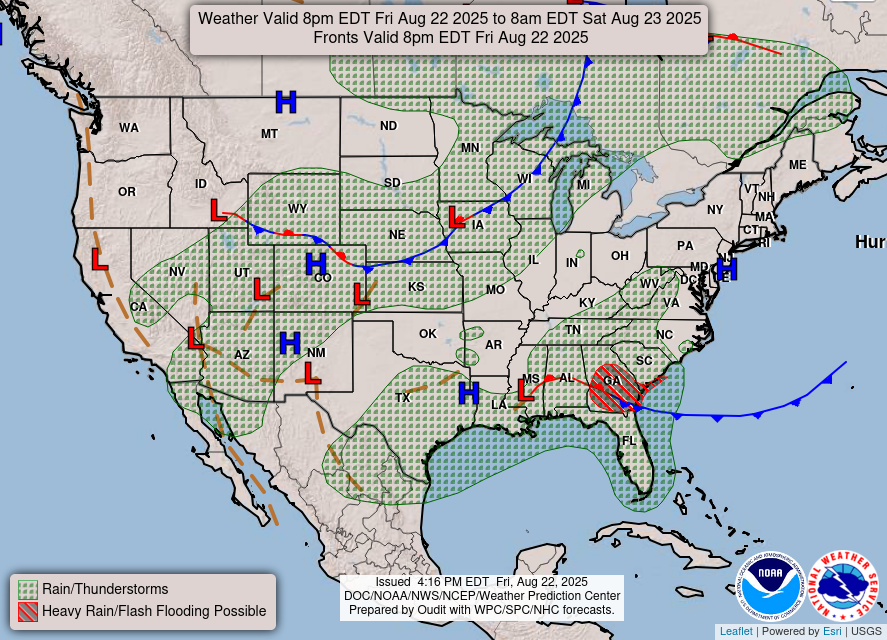
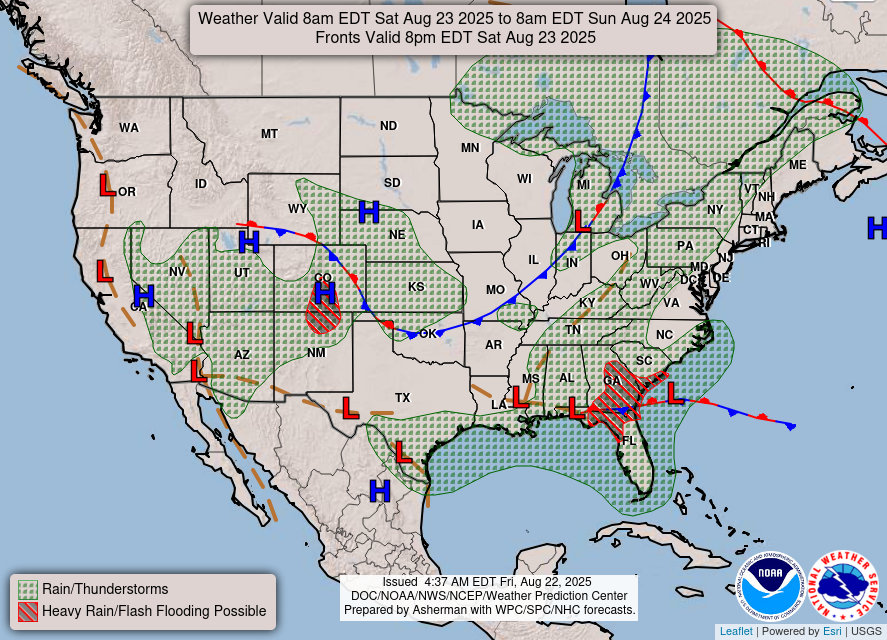
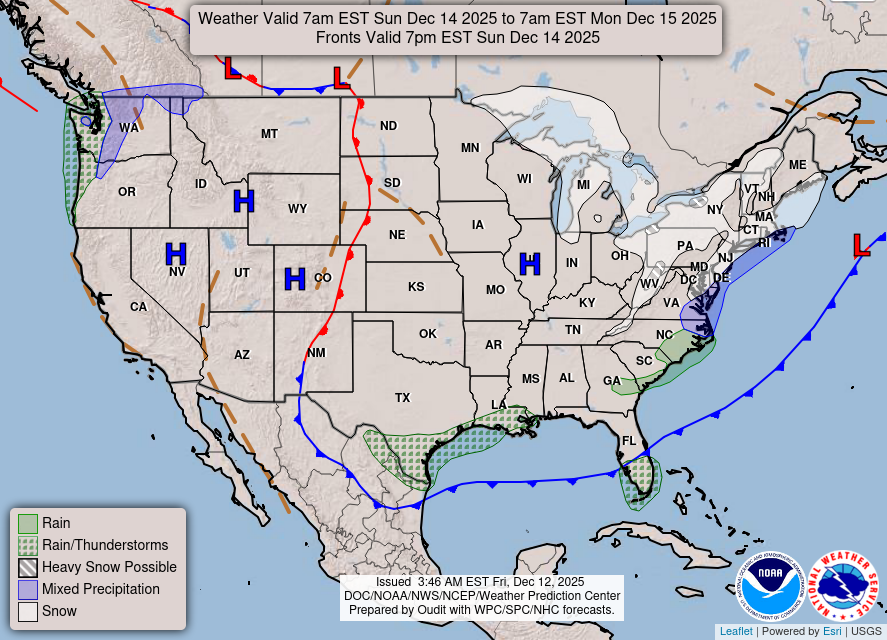
National Forecast Chart
Valid Thu Oct 15, 2026
Valid Fri Oct 16, 2026
Valid Sat Oct 17, 2026
Image Format:
» Interactive National Forecast Chart
+ Additional Links
+ Additional Links
- » Description of the National Forecast Chart
- » Product Archives
- » Download hazards in KML or shapefile format or GeoJSON format
WPC Top Stories:

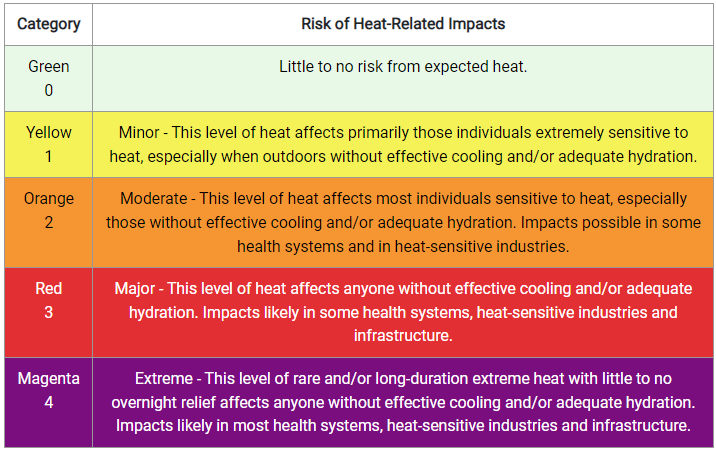
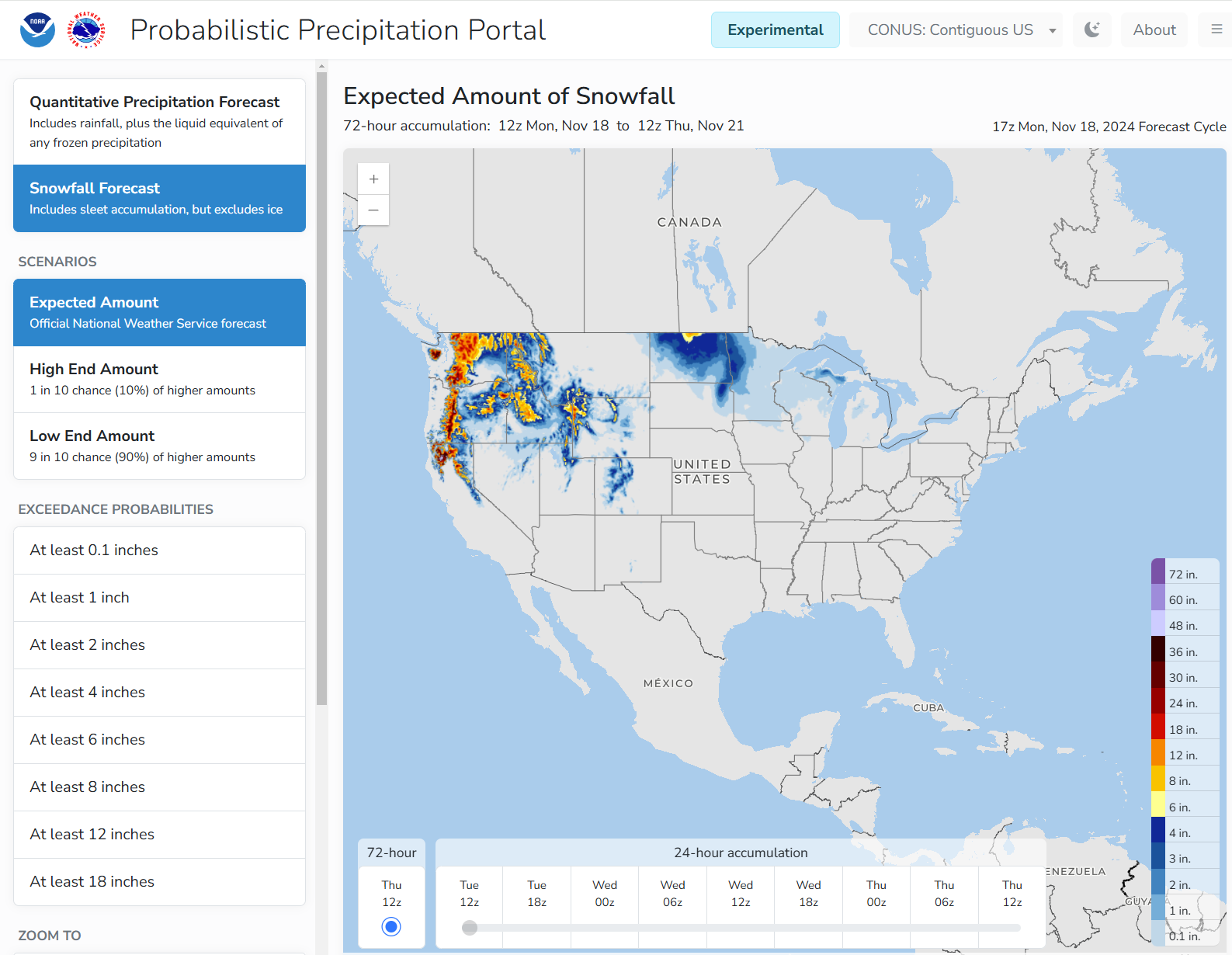
North American Surface Analysis Legacy Page:
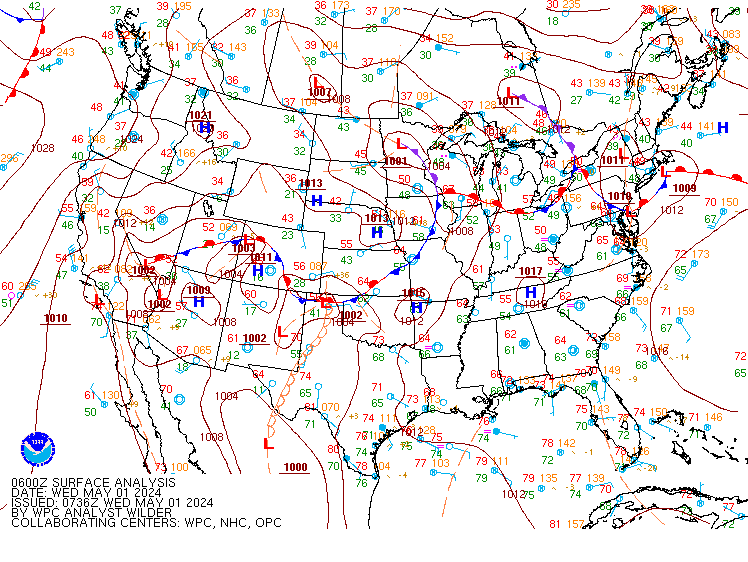
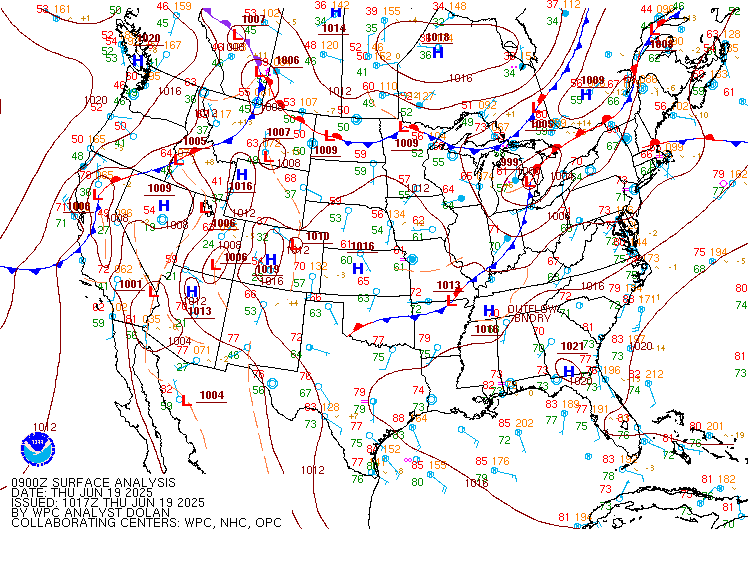
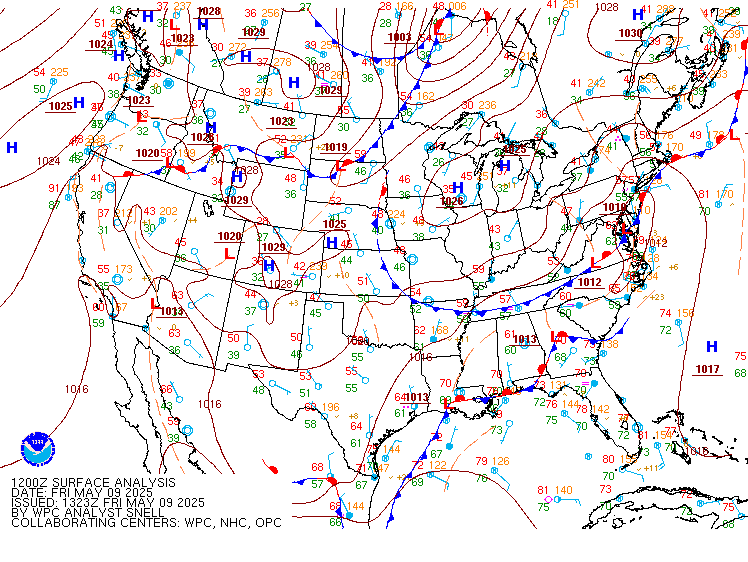
Analyzed at 03Z Thu Oct 15, 2026
Analyzed at 06Z Thu Oct 15, 2026
Analyzed at 09Z Thu Oct 15, 2026
Analyzed at 12Z Thu Oct 15, 2026
Analyzed at 15Z Thu Oct 15, 2026
Analyzed at 18Z Thu Oct 15, 2026
Analyzed at 21Z Thu Oct 15, 2026
Analyzed at 00Z Fri Oct 16, 2026
Analyzed at 03Z Fri Oct 16, 2026
Image Format:

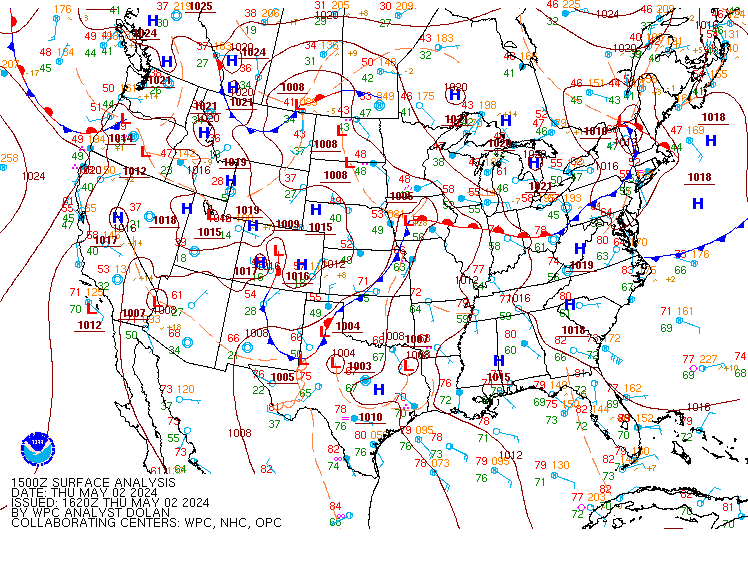
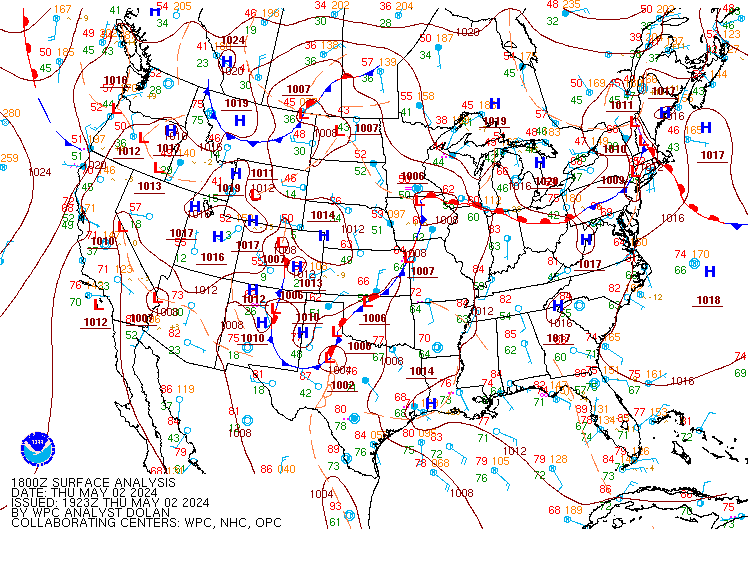
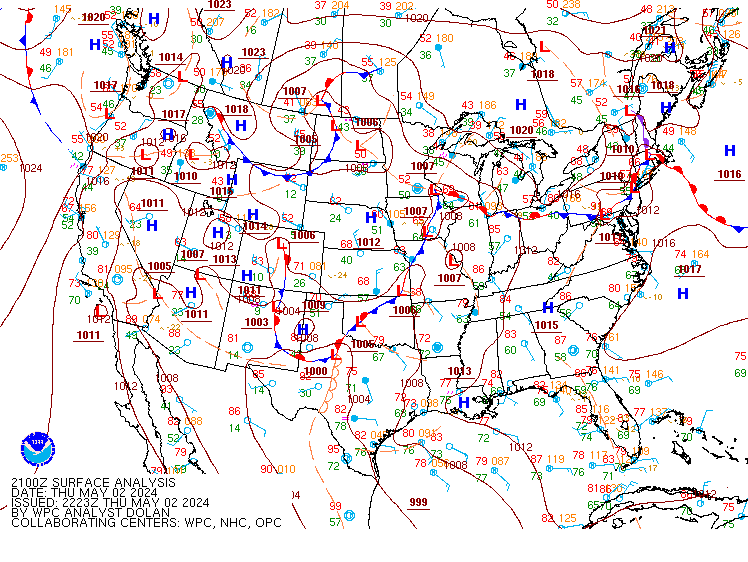
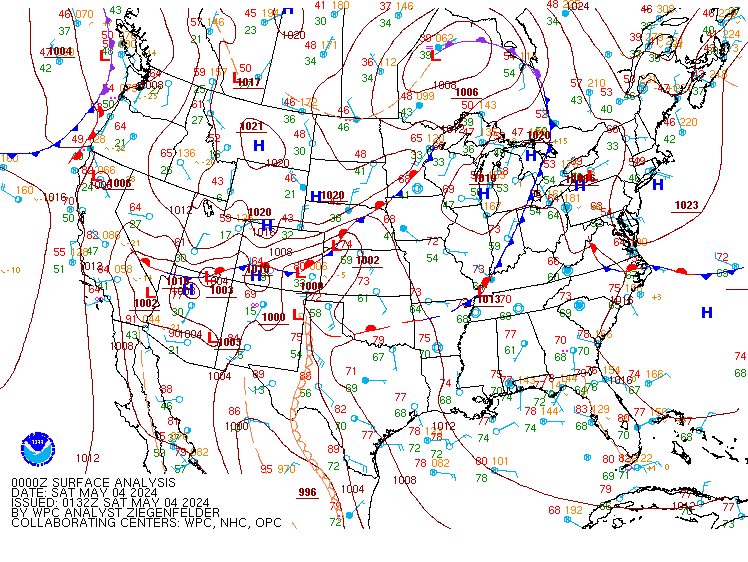
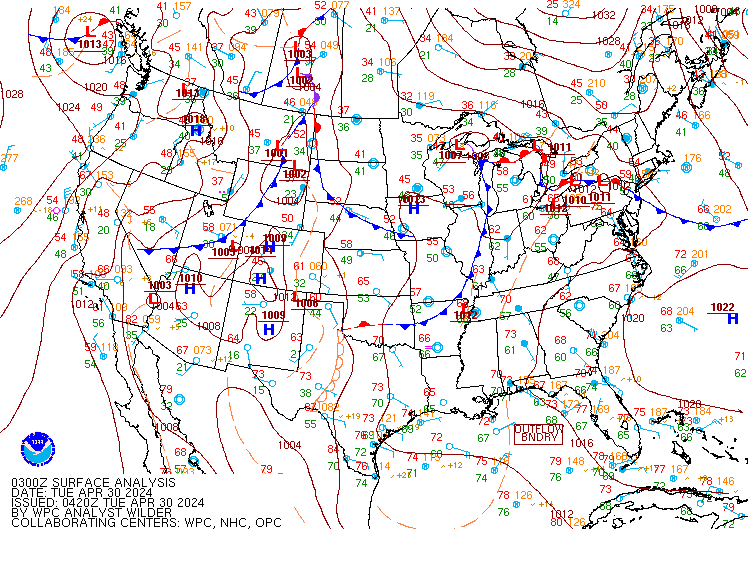
Surface Fronts and Sea-Level Pressures Legacy Page:
Analyzed 03Z Fri Oct 16, 2026
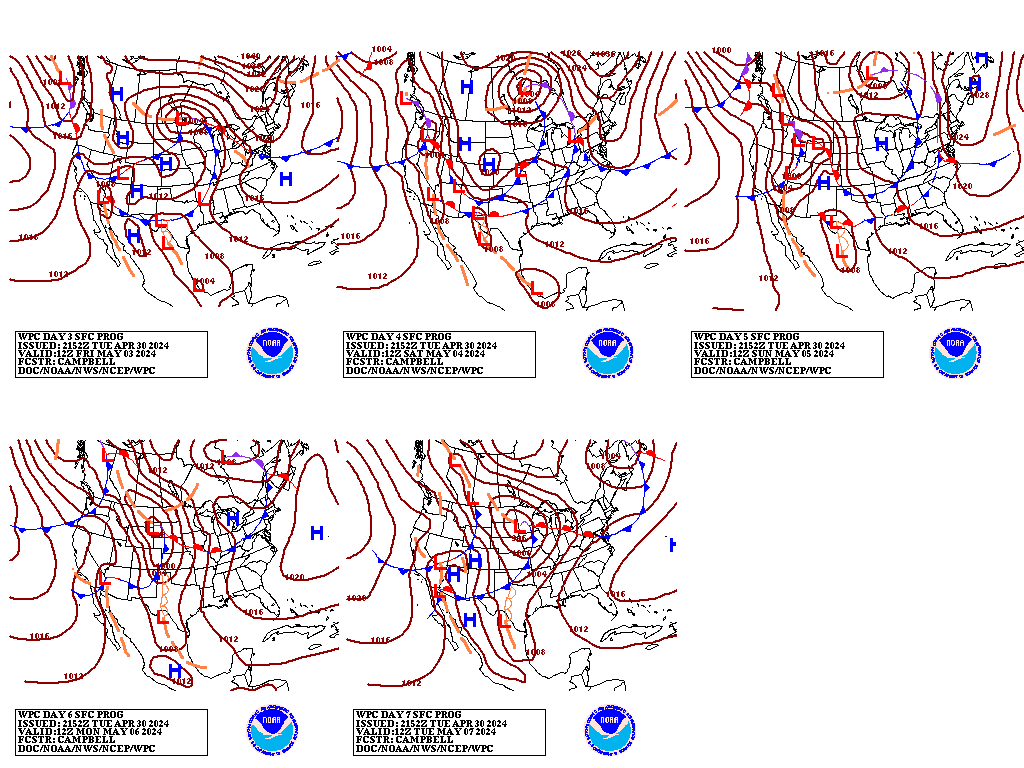
Valid 06Z Fri Oct 16, 2026
Valid 12Z Fri Oct 16, 2026
Valid 18Z Fri Oct 16, 2026
Valid 00Z Sat Oct 17, 2026
Valid 12Z Sat Oct 17, 2026
Valid 00Z Sun Oct 18, 2026
Valid 12Z Sun Oct 18, 2026
Valid 12Z Mon Oct 19, 2026
Valid 12Z Tue Oct 20, 2026
Valid 12Z Wed Oct 21, 2026
Valid 12Z Thu Oct 22, 2026
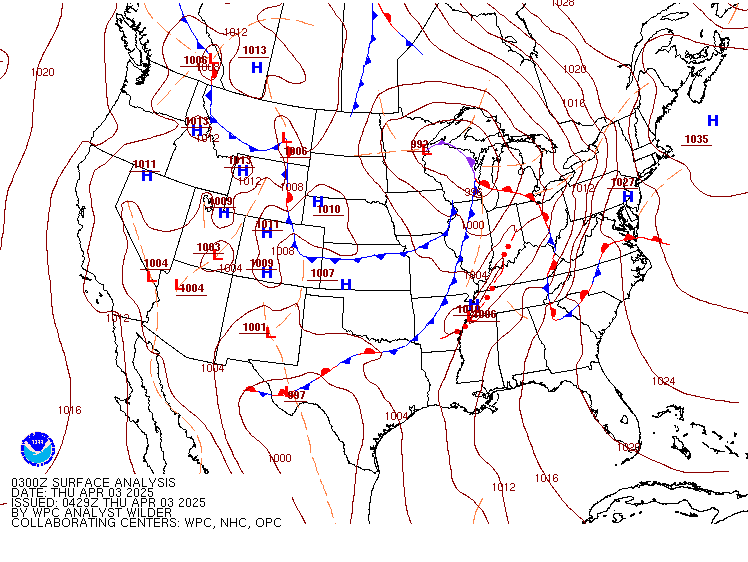


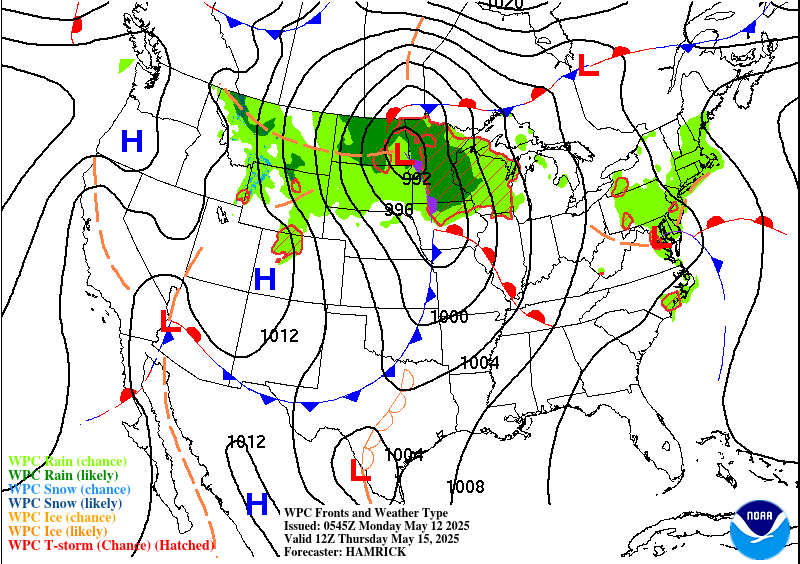
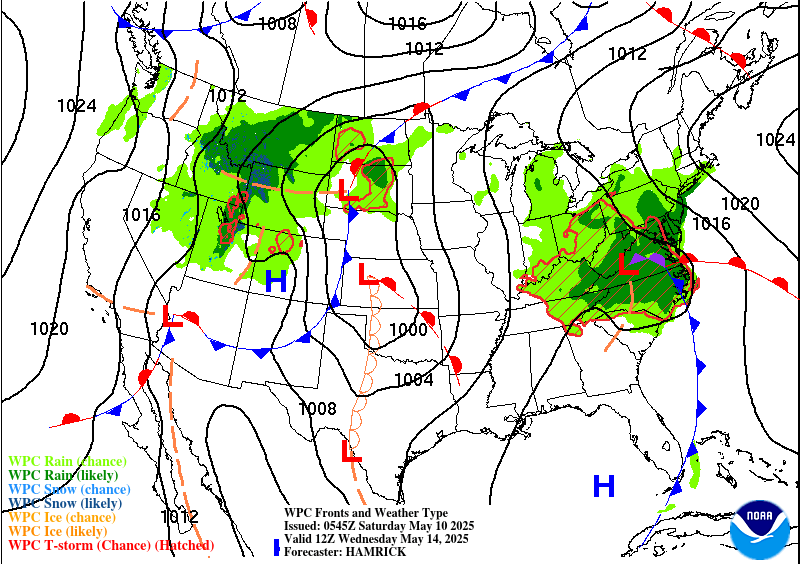
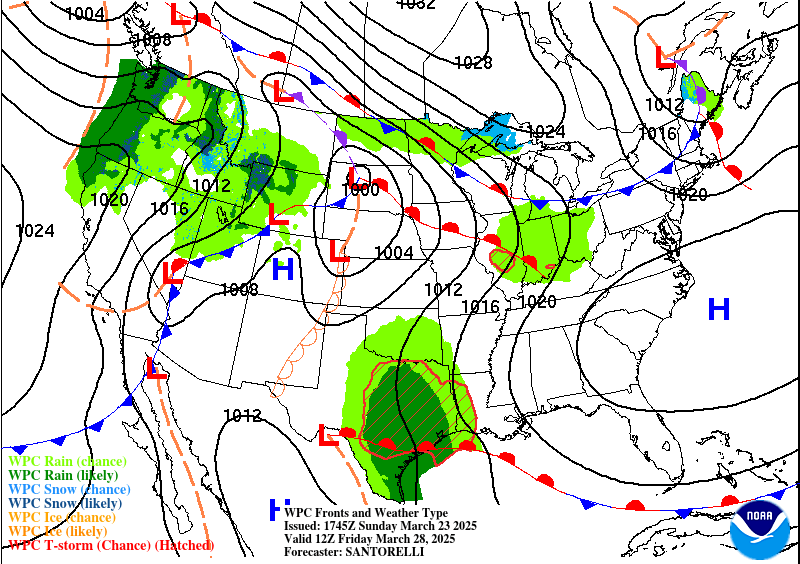
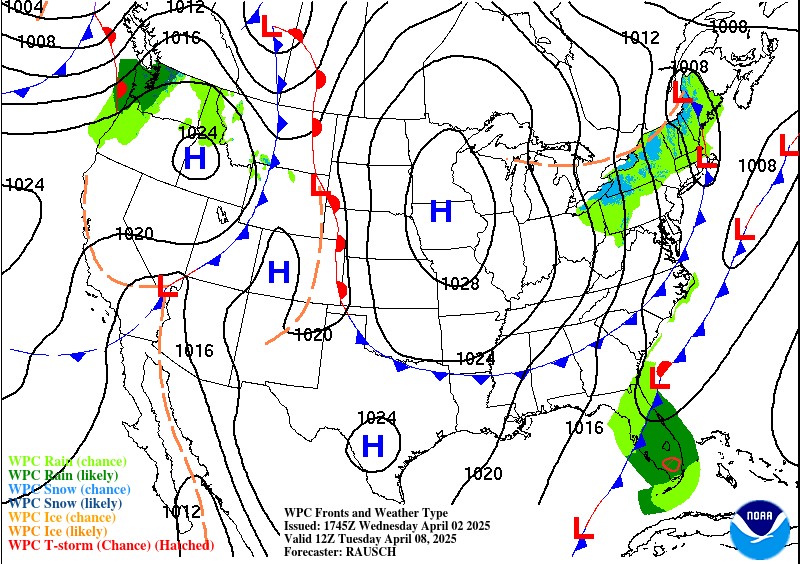
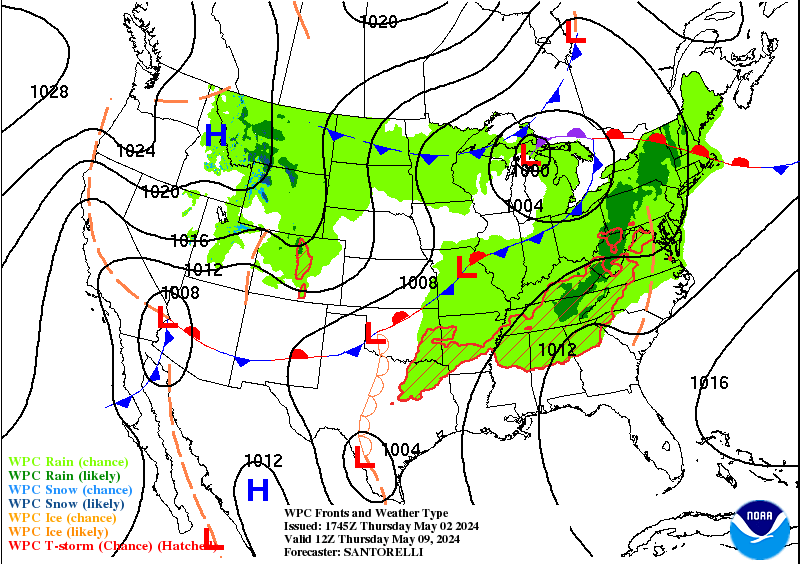
+ Short Range Forecast Discussion (Day ½-2½)
+ Medium Range Forecast Discussion (Day 3-7)
+ Additional Links
Short Range Forecast Discussion
NWS Weather Prediction Center College Park MD
245 PM EDT Thu Oct 15 2026

Valid 00Z Fri Oct 16 2026 - 00Z Sun Oct 18 2026

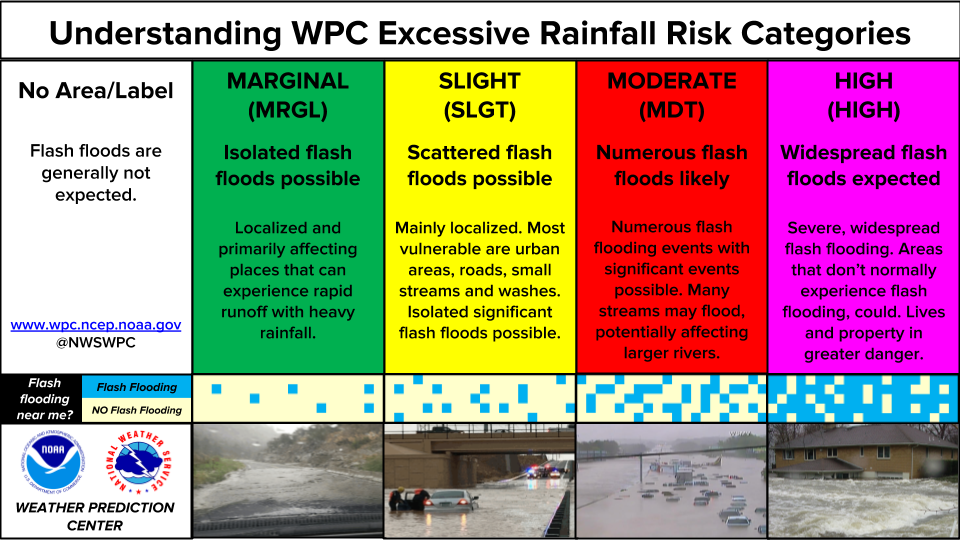
...There is a Moderate Risk (level 3/4) of excessive rainfall over
parts of the Southern Plains on Thursday...

...There is a Slight Risk (level 2/5) of severe thunderstorms over
parts of the Ohio Valley on Thursday...

...There is a Slight Risk (level 2/5) of severe thunderstorms over
parts of the Mid-Atlantic on Friday...

Low pressure over the Middle Mississippi Valley will move
northeastward to the Canadian Maritimes Provinces by late Friday
evening. Moisture from the Gulf will pool along and ahead of the
front over the Southern Plains, producing showers and
thunderstorms with heavy rain on Thursday. Therefore, the WPC has
issued a Moderate Risk (level 3/4) of excessive rainfall over
parts of the Southern Plains on Thursday through Friday morning.
Numerous flash flooding events are possible. In addition, many
streams may flood, potentially affecting larger rivers. The
flooding may include debris flows in or near recently burned areas.

Rain will develop over parts of the Upper/Middle Mississippi
Valley on Thursday, then move into the Great Lakes overnight
Thursday and into the Northeast on Friday. Wet snow will develop
over parts of the Northeast/Lower Great Lakes on Saturday morning.

The SPC has also issued a Slight Risk (level 2/5) of severe
thunderstorms over the Ohio Valley Thursday through Friday
morning.  The hazards associated with these thunderstorms are
frequent lightning, severe thunderstorm wind gusts, hail, and a
few tornadoes.

The threat of severe thunderstorms moves eastward on Friday as the
SPC has issued a Slight Risk (level 2/5) of severe thunderstorms
over parts of the Mid-Atlantic Friday through Saturday morning.
Hazards associated with these thunderstorms include frequent
lightning, severe thunderstorm wind gusts, a few tornadoes, and a
minimal threat of hail.

Also on Friday morning, rain will continue over parts of western
Texas with showers and thunderstorms near the Gulf Coast. The rain
will move into the Central Appalachians by Friday afternoon and
into the Mid-Atlantic by Friday evening.  On Friday evening,
showers and thunderstorms will develop over parts of Florida.  The
rain mainly ends over most of the Northeast. However, light wet
snow will develop over higher elevations in the Northeast. Rain
will move into the Carolinas by Saturday morning.

Lastly, a front will move onshore over parts of the Pacific
Northwest by Saturday morning, producing light rain in parts of
the area. Rain showers will develop over parts of the Southwest
Friday afternoon into Saturday.


Ziegenfelder


Graphics available at
https://www.wpc.ncep.noaa.gov/basicwx/basicwx_ndfd.php
Extended Forecast Discussion
NWS Weather Prediction Center College Park MD
412 PM EDT Thu Oct 15 2026

Valid 12Z Sun Oct 18 2026 - 12Z Thu Oct 22 2026


...Frost/freeze threats across parts of the Mid-Atlantic and
Northeast Sunday and Monday...

...A possible East Coast low early to mid next week could bring
coastal impacts...


...Overview...

A chilly surface high over the eastern U.S. will bring frost and
freeze concerns to parts of the Mid-Atlantic and Northeast early in
the period. A cold front sinking through Florida may bring a
threat for locally heavy rainfall on Sunday into Monday. There is
also increasing potential for a low pressure system to develop off
the East Coast along this front, which may bring coastal impacts
depending on how close to the coast the low gets. Out West, an
upper low will drop down the West Coast with deep troughing likely
over the West by next Thursday. This brings the potential for
widespread rain and high elevation snows especially Tuesday and
Wednesday next week, with some showers increasing across the
Central U.S. as well late period.


...Guidance/Predictability Assessment...

The latest model trends continue to favor the development of a low
pressure system somewhere off the Mid-Atlantic/Southeast coast in
the western Atlantic either later this weekend or early next week.
Despite these trends, uncertainty remains high as the location and
timing of development, degree of amplification, strength, and track
all remain in question. As a result, the WPC forecast utilized a
blend that tried to take a middle ground approach, while leaning
towards a more developed and relatively closer to the coast
solution. This ended up being primarily a non-NCEP consensus with
increasing weight on the EC ensemble mean beyond Day 5. Given the
potential for coastal impacts with a possibly stronger and closer
coastal low next week, model trends will need to be monitored in
the coming days as future forecast adjustments could be dramatic.

Out West, the latest guidance shows better agreement with the
evolution of an upper trough that drops southward along the coast
and eventually closes off into a closed low over the Southwest late
this weekend into next week. The slower and more amplified
solutions are looking more likely to verify, which will result in a
slower progression of inland penetration of precipitation and a
generally warmer system evolution featuring mostly rain and only
high elevation snow above 9000-10000 feet.


...Weather/Hazards Highlights...

A cold front moving slowly southward through Florida will allow
for increased onshore flow and locally heavy rainfall, especially
along the East Coast. WPC has this region in a marginal risk for
Sunday. Coastal low pressure development off the Mid-Atlantic coast
may allow for more showers and locally heavy rainfall for the
eastern Carolinas and southeast Virginia, with possible gusty
winds; however, concerns for coastal impacts are all highly
dependent on how close to the coast this low forms, which is still
high uncertain. A closer low would mean much greater impacts (high
winds, rough surf, coastal flooding, etc), especially if the low
lingers for any period of time. Out West, precipitation chances
increase by Monday and especially Tuesday into Wednesday with rain
and high elevation snow. Some rainfall may begin to develop across
the south-central U.S. by mid next week as well.

Canadian high pressure will be in place across much of the East on
Sunday, with frost/freeze concerns for parts of the Mid-Atlantic
and the Northeast. Elsewhere, above normal temperatures will expand
across the Central U.S. as conditions trend cooler across the West
underneath deep troughing next week.


Miller/Santorelli


Additional 3-7 Day Hazard information can be found on the WPC
medium range hazards outlook chart at:
https://www.wpc.ncep.noaa.gov/threats/threats.php

WPC medium range 500mb heights, surface systems, weather grids,
quantitative precipitation forecast, excessive rainfall outlook,
winter weather outlook probabilities, heat indices and Key Messages
are at:

https://www.wpc.ncep.noaa.gov/medr/5dayfcst500_wbg.gif
https://www.wpc.ncep.noaa.gov/medr/5dayfcst_wbg_conus.gif
https://www.wpc.ncep.noaa.gov/5km_grids/5km_gridsbody.html
https://www.wpc.ncep.noaa.gov/qpf/day4-7.shtml
https://www.wpc.ncep.noaa.gov/#page=ero
https://www.wpc.ncep.noaa.gov/wwd/pwpf_d47/pwpf_medr.php?day=4
https://www.wpc.ncep.noaa.gov/heat_index.shtml
https://www.wpc.ncep.noaa.gov/#page=ovw
Quantitative Precipitation Forecasts Legacy Page:
Valid 00Z 10/19/2026 - 00Z 10/20/2026
Valid 00Z 10/20/2026 - 00Z 10/21/2026
Valid 00Z 10/21/2026 - 00Z 10/22/2026
Valid 00Z 10/22/2026 - 00Z 10/23/2026
Valid 00Z 10/16/2026 - 12Z 10/16/2026
Valid 06Z 10/16/2026 - 18Z 10/16/2026
Valid 12Z 10/16/2026 - 00Z 10/17/2026
Valid 18Z 10/16/2026 - 06Z 10/17/2026
Valid 00Z 10/17/2026 - 12Z 10/17/2026
Valid 06Z 10/17/2026 - 18Z 10/17/2026
Valid 12Z 10/17/2026 - 00Z 10/18/2026
Valid 18Z 10/17/2026 - 06Z 10/18/2026
Valid 00Z 10/18/2026 - 12Z 10/18/2026
Valid 06Z 10/18/2026 - 18Z 10/18/2026
Valid 12Z 10/18/2026 - 00Z 10/19/2026


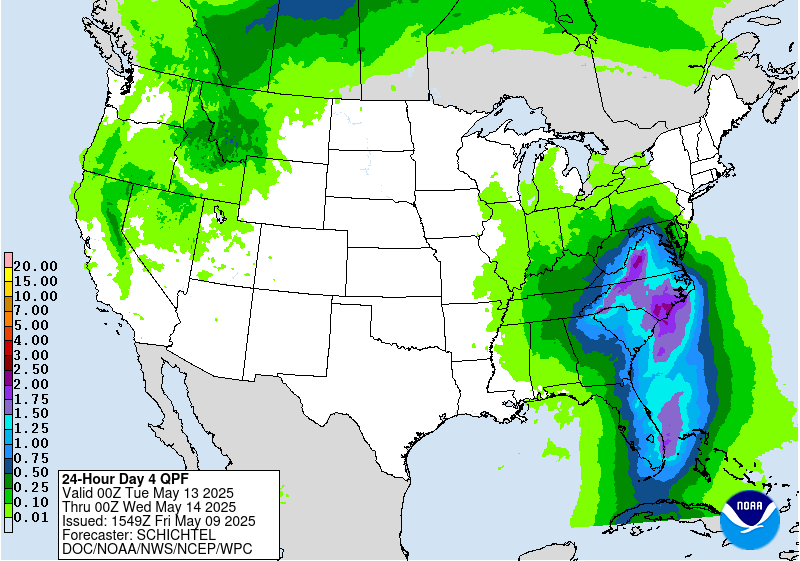


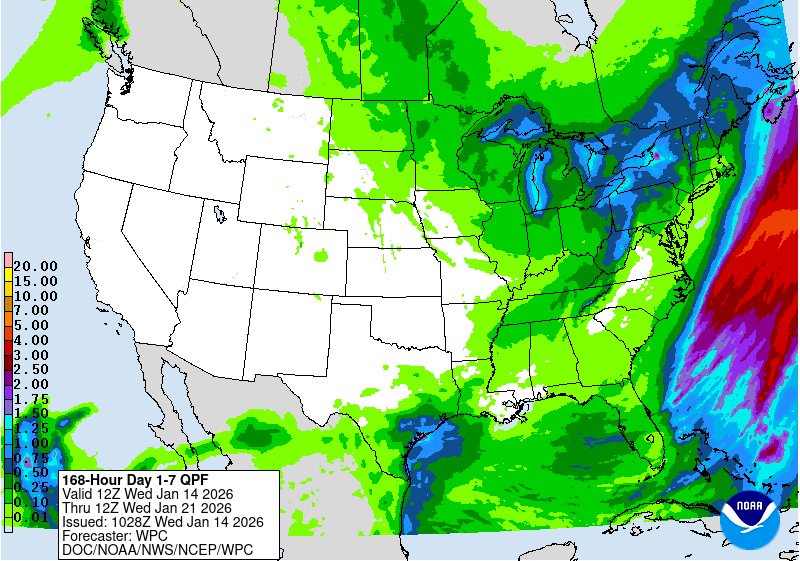


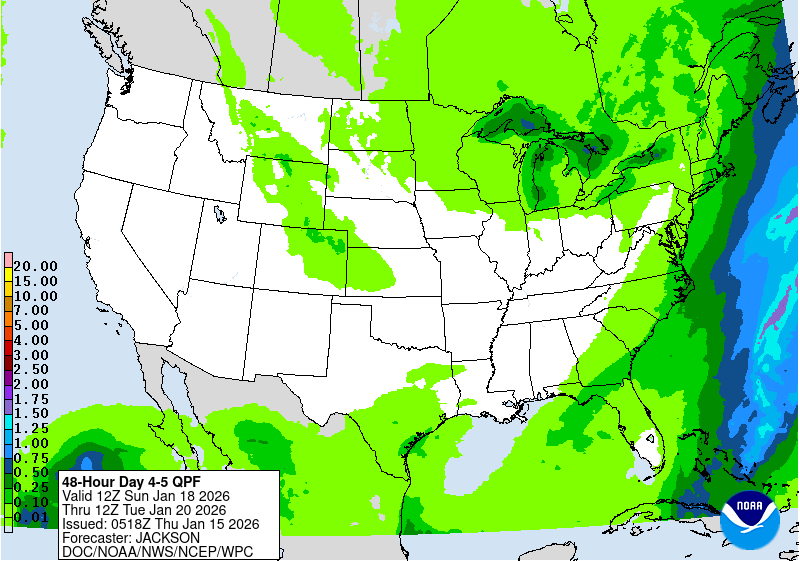
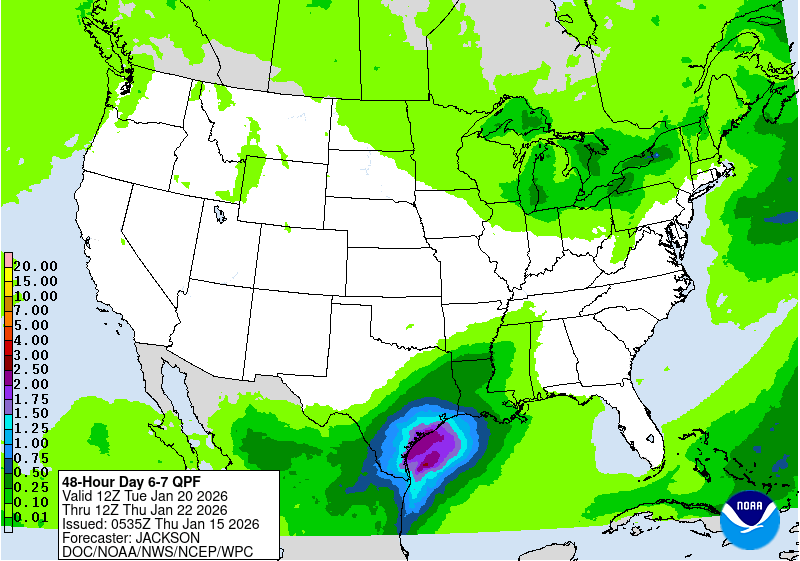
» View
Probabilistic Precipitation Guidance (Day 1-3)
» Extreme Precipitation Monitor
+ Additional Links
» Extreme Precipitation Monitor
+ Additional Links
- » Product Verification
- » Product Archive
- » Product Info
- » Additional formats of QPF: GRIB 2 | Shapefiles | KML
- » Other QPF Products
Excessive Rainfall Forecasts Legacy Page:
Valid 01Z Fri Oct 16 2026 - 12Z Fri Oct 16 2026
Valid 12Z Fri Oct 16 2026 - 12Z Sat Oct 17 2026
Valid 12Z Sat Oct 17 2026 - 12Z Sun Oct 18 2026
Valid 12Z Fri Oct 16 2026 - 12Z Sat Oct 17 2026
Valid 12Z Sat Oct 17 2026 - 12Z Sun Oct 18 2026
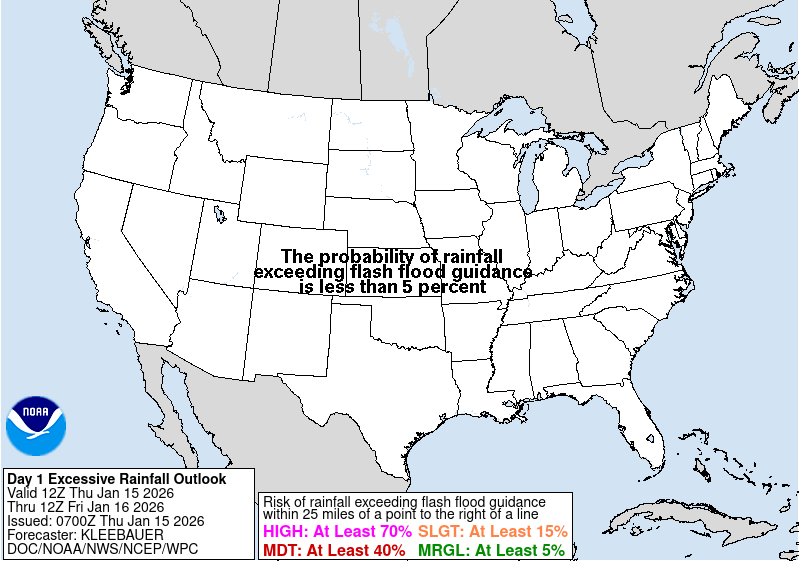
+ Forecast Discussion
Excessive Rainfall Discussion
NWS Weather Prediction Center College Park MD
801 PM EDT Thu Oct 15 2026
Day 1
Valid 01Z Fri Oct 16 2026 - 12Z Fri Oct 16 2026
...THERE IS A MODERATE RISK OF EXCESSIVE RAINFALL ACROSS PORTIONS
OF WEST TEXAS...
01Z Update: Updates to the Day 1 ERO were mainly to trim the
western portions of the outlook areas across TX -- areas now west
of the front and (thus) quite a bit more stable following the
FROPA. Elsewhere, based on the latest observational trends
(radar/satellite/mesoanalysis), along with the trends in recent
HRRR runs and with the 18Z HREF and REFS QPF exceedance
probabilities, have removed a large portion of the Marginal Risk
area across the MOKSAROK, the Mid MS Valley, and parts of the
western OH Valley.
Hurley
Previous discussion...
The setup for Thursday into early Friday morning continues to trend
towards a very active period across portions of the Southern Plains
as a cold front drives south with the aid of a strengthening
surface ridge emanating out Canada. Complex longwave evolution
will generate quite a strong surface response with high pressure
nosing out of western Canada, eventually strengthening into a 1040+
mb high centering over Montana by later this afternoon. This will
finally push the front bisecting the Plains through the Ohio Valley
southward creating a focused area of low-level convergence as it
interacts with rich theta_E air positioned over the Southern Plains
of OK/TX. Current surface analysis maintains our ridge across the
Lower Mississippi Valley with a prevailing south to southwest fetch
out of the adjacent Gulf, leading to a fairly pronounced deep
layer moisture source across much of the Lone Star state and the
eastern half of OK. PWATs centered over west TX up through OK
remain very much elevated with the 00z RAOB's out of both KOUN and
KMAF indicating PWAT anomalies encroaching on +2 to +3 standard
deviations when accounting for climatology. This is also well above
the 90th percentile with the NAEFS outputs signaling closer to the
upper 97-99th percentile when adjusting for seasonal climo, so the
environmental conditioning is more than favorable for prospects of
heavy rainfall in any convective regimes.
Streaming mid- level vorticity within the western flank of our
ridge over the Southeast CONUS will continue for at least another
24 hours before the general pattern, both at the surface and aloft,
finally shifts and the threat for significant convective coverage
and associated impacts diminishes across the region. Classic low-
level convergence regime with the front will allow for the standard
continuation of convection over the Southern Plains the first part
of Thursday with the eventual decay in the magnitude for a short
time late-morning into the afternoon. By the mid to late-afternoon
time frame, we'll begin seeing our front take a dive south as it
begins feeling the pressure gradient pattern building over the
Plains and Northern Rockies thanks to our maturing high out of the
Canadian Prairies. By the following evening (Thursday night), the
nocturnal LLJ will respond ahead of the approaching boundary
leading to enhanced low to mid-level convergence from the eastern
Permian Basin down through the adjacent Concho Valley, into the Big
Bend and Lower Trans Pecos. The further south the setup, the more
prolonged the heavy convective regime will last creating a
cumulative effect of all the heavy rain occurring during the
period.
A noteworthy precipitation gradient can be seen within the ensemble
means with heavy QPF signatures over the Big Bend to Lower Trans
Pecos with a gradient decline as you move northward. Areal average
QPF between 3-5" with locally higher amounts are anticipated along
and south of I-10, mainly east of the Davis Mountains with the
maxima centered over the Lower Pecos River basin between Sanderson
to north of Del Rio. 00z HREF/REFS neighborhood probabilities
continue to pinpoint 70-100% exceedance probs for >3" with even a
pocket of 50-80% for >5" positioned over Terrell county in the Big
Bend up through portions of the Lower Concho Valley. This is the
area where the convective pattern will linger the longest before
the eventual frontal progression pushes the front through the area,
but it's also the area with the greatest instability and deep layer
moisture presence when assessing raw PWAT indices being forecast.
Considering such a robust signal, the previous MDT risk forecast is
still very much in play with only minor modifications to the risk
itself from the previous issuance. Continuity and the enhanced
probabilities maintain a favorable prospect for widespread flash
flooding across the aforementioned areas with even a threat for
areas north around the central Concho Valley, including the San
Angelo area and surrounds. The SLGT risk extends further north into
southern OK with the initial convective threat carrying over from
the morning hours and some overlap in the afternoon on initiation
before the front finally pushes through the air and dry air
advection in wake of the front puts an end to the threat. DFW metro
will be right on the edge of seeing more appreciable rainfall, but
current progs are the worst stays just outside the metroplex this
period. Will be something to monitor moving forward, but the area
remains in the MRGL encompassing the outskirts of the main axis of
heavier precip and associated SLGT risk.
Kleebauer
Day 1 threat area: www.wpc.ncep.noaa.gov/qpf/94epoints.txt
Excessive Rainfall Discussion
NWS Weather Prediction Center College Park MD
801 PM EDT Thu Oct 15 2026
Day 2
Valid 12Z Fri Oct 16 2026 - 12Z Sat Oct 17 2026
...THERE IS A MARGINAL RISK OF EXCESSIVE RAINFALL ACROSS PORTIONS
OF CENTRAL AND SOUTHERN FLORIDA...
Flow across the region will become more southerly ahead of an
amplifying trough moving into the easterly U.S. This will support
increasing moisture, with PWs climbing to at or above 2 inches (or
around 2 std dev above normal) across much of central and southern
Florida on Friday. This will support efficient rain-producing
storms, with slow storm motion raising the threat for localized
heavy accumulations. The Marginal Risk highlights the area where
the HREF and REFS both generally show higher (greater than 50
percent) probabilities for accumulations exceeding 3 inches.
Pereira
Day 2 threat area: www.wpc.ncep.noaa.gov/qpf/98epoints.txt
Excessive Rainfall Discussion
NWS Weather Prediction Center College Park MD
801 PM EDT Thu Oct 15 2026
Day 3
Valid 12Z Sat Oct 17 2026 - 12Z Sun Oct 18 2026
...THERE IS A MARGINAL RISK OF EXCESSIVE RAINFALL ALONG PORTIONS
OF THE FLORIDA EAST COAST...
20Z Update...
No changes were made to the previous outlook.
Pereira
Previous discussion...
Cold front will be pushing through the Florida Peninsula by Friday
night and maintaining slow progression southward through Saturday
with a bit of a frictional convergence regime along the east coast.
Surface ridging to the north coupled with the front will allow for
prevailing east to northeast flow off the nearby Atlantic with
focused convergence along the front as it motions south. Current
progs are for the front to be aligned between Melbourne and West
Palm Beach by Saturday afternoon which should coincide with the
diurnal max instability. As of now, the signal shows convection
confined right along the coast with little progression inland, so
the threat for any heavy rainfall is along that immediate coastal
plain. That said, that's the main population center with urban
sprawl up and down this area of the state, and with the environment
conducive for locally 2-3"/hr within any convective cores, imagine
isolated totals of 4-6" are very much plausible in this scenario.
It's a tricky setup with low areal coverage of heavy rain potential
given the expected proxy to the coast. Considering the marginal
signal within the global deterministic and ensemble bias
correction, the previous MRGL risk was maintained with no
adjustment.
Kleebauer
Day 3 threat area: www.wpc.ncep.noaa.gov/qpf/99epoints.txt
+ Additional Links
Excessive Rainfall Discussion
NWS Weather Prediction Center College Park MD
801 PM EDT Thu Oct 15 2026
Day 1
Valid 01Z Fri Oct 16 2026 - 12Z Fri Oct 16 2026
...THERE IS A MODERATE RISK OF EXCESSIVE RAINFALL ACROSS PORTIONS
OF WEST TEXAS...
01Z Update: Updates to the Day 1 ERO were mainly to trim the
western portions of the outlook areas across TX -- areas now west
of the front and (thus) quite a bit more stable following the
FROPA. Elsewhere, based on the latest observational trends
(radar/satellite/mesoanalysis), along with the trends in recent
HRRR runs and with the 18Z HREF and REFS QPF exceedance
probabilities, have removed a large portion of the Marginal Risk
area across the MOKSAROK, the Mid MS Valley, and parts of the
western OH Valley.
Hurley
Previous discussion...
The setup for Thursday into early Friday morning continues to trend
towards a very active period across portions of the Southern Plains
as a cold front drives south with the aid of a strengthening
surface ridge emanating out Canada. Complex longwave evolution
will generate quite a strong surface response with high pressure
nosing out of western Canada, eventually strengthening into a 1040+
mb high centering over Montana by later this afternoon. This will
finally push the front bisecting the Plains through the Ohio Valley
southward creating a focused area of low-level convergence as it
interacts with rich theta_E air positioned over the Southern Plains
of OK/TX. Current surface analysis maintains our ridge across the
Lower Mississippi Valley with a prevailing south to southwest fetch
out of the adjacent Gulf, leading to a fairly pronounced deep
layer moisture source across much of the Lone Star state and the
eastern half of OK. PWATs centered over west TX up through OK
remain very much elevated with the 00z RAOB's out of both KOUN and
KMAF indicating PWAT anomalies encroaching on +2 to +3 standard
deviations when accounting for climatology. This is also well above
the 90th percentile with the NAEFS outputs signaling closer to the
upper 97-99th percentile when adjusting for seasonal climo, so the
environmental conditioning is more than favorable for prospects of
heavy rainfall in any convective regimes.
Streaming mid- level vorticity within the western flank of our
ridge over the Southeast CONUS will continue for at least another
24 hours before the general pattern, both at the surface and aloft,
finally shifts and the threat for significant convective coverage
and associated impacts diminishes across the region. Classic low-
level convergence regime with the front will allow for the standard
continuation of convection over the Southern Plains the first part
of Thursday with the eventual decay in the magnitude for a short
time late-morning into the afternoon. By the mid to late-afternoon
time frame, we'll begin seeing our front take a dive south as it
begins feeling the pressure gradient pattern building over the
Plains and Northern Rockies thanks to our maturing high out of the
Canadian Prairies. By the following evening (Thursday night), the
nocturnal LLJ will respond ahead of the approaching boundary
leading to enhanced low to mid-level convergence from the eastern
Permian Basin down through the adjacent Concho Valley, into the Big
Bend and Lower Trans Pecos. The further south the setup, the more
prolonged the heavy convective regime will last creating a
cumulative effect of all the heavy rain occurring during the
period.
A noteworthy precipitation gradient can be seen within the ensemble
means with heavy QPF signatures over the Big Bend to Lower Trans
Pecos with a gradient decline as you move northward. Areal average
QPF between 3-5" with locally higher amounts are anticipated along
and south of I-10, mainly east of the Davis Mountains with the
maxima centered over the Lower Pecos River basin between Sanderson
to north of Del Rio. 00z HREF/REFS neighborhood probabilities
continue to pinpoint 70-100% exceedance probs for >3" with even a
pocket of 50-80% for >5" positioned over Terrell county in the Big
Bend up through portions of the Lower Concho Valley. This is the
area where the convective pattern will linger the longest before
the eventual frontal progression pushes the front through the area,
but it's also the area with the greatest instability and deep layer
moisture presence when assessing raw PWAT indices being forecast.
Considering such a robust signal, the previous MDT risk forecast is
still very much in play with only minor modifications to the risk
itself from the previous issuance. Continuity and the enhanced
probabilities maintain a favorable prospect for widespread flash
flooding across the aforementioned areas with even a threat for
areas north around the central Concho Valley, including the San
Angelo area and surrounds. The SLGT risk extends further north into
southern OK with the initial convective threat carrying over from
the morning hours and some overlap in the afternoon on initiation
before the front finally pushes through the air and dry air
advection in wake of the front puts an end to the threat. DFW metro
will be right on the edge of seeing more appreciable rainfall, but
current progs are the worst stays just outside the metroplex this
period. Will be something to monitor moving forward, but the area
remains in the MRGL encompassing the outskirts of the main axis of
heavier precip and associated SLGT risk.
Kleebauer
Day 1 threat area: www.wpc.ncep.noaa.gov/qpf/94epoints.txt
Excessive Rainfall Discussion
NWS Weather Prediction Center College Park MD
801 PM EDT Thu Oct 15 2026
Day 2
Valid 12Z Fri Oct 16 2026 - 12Z Sat Oct 17 2026
...THERE IS A MARGINAL RISK OF EXCESSIVE RAINFALL ACROSS PORTIONS
OF CENTRAL AND SOUTHERN FLORIDA...
Flow across the region will become more southerly ahead of an
amplifying trough moving into the easterly U.S. This will support
increasing moisture, with PWs climbing to at or above 2 inches (or
around 2 std dev above normal) across much of central and southern
Florida on Friday. This will support efficient rain-producing
storms, with slow storm motion raising the threat for localized
heavy accumulations. The Marginal Risk highlights the area where
the HREF and REFS both generally show higher (greater than 50
percent) probabilities for accumulations exceeding 3 inches.
Pereira
Day 2 threat area: www.wpc.ncep.noaa.gov/qpf/98epoints.txt
Excessive Rainfall Discussion
NWS Weather Prediction Center College Park MD
801 PM EDT Thu Oct 15 2026
Day 3
Valid 12Z Sat Oct 17 2026 - 12Z Sun Oct 18 2026
...THERE IS A MARGINAL RISK OF EXCESSIVE RAINFALL ALONG PORTIONS
OF THE FLORIDA EAST COAST...
20Z Update...
No changes were made to the previous outlook.
Pereira
Previous discussion...
Cold front will be pushing through the Florida Peninsula by Friday
night and maintaining slow progression southward through Saturday
with a bit of a frictional convergence regime along the east coast.
Surface ridging to the north coupled with the front will allow for
prevailing east to northeast flow off the nearby Atlantic with
focused convergence along the front as it motions south. Current
progs are for the front to be aligned between Melbourne and West
Palm Beach by Saturday afternoon which should coincide with the
diurnal max instability. As of now, the signal shows convection
confined right along the coast with little progression inland, so
the threat for any heavy rainfall is along that immediate coastal
plain. That said, that's the main population center with urban
sprawl up and down this area of the state, and with the environment
conducive for locally 2-3"/hr within any convective cores, imagine
isolated totals of 4-6" are very much plausible in this scenario.
It's a tricky setup with low areal coverage of heavy rain potential
given the expected proxy to the coast. Considering the marginal
signal within the global deterministic and ensemble bias
correction, the previous MRGL risk was maintained with no
adjustment.
Kleebauer
Day 3 threat area: www.wpc.ncep.noaa.gov/qpf/99epoints.txt
Winter Weather Forecasts Legacy Page:
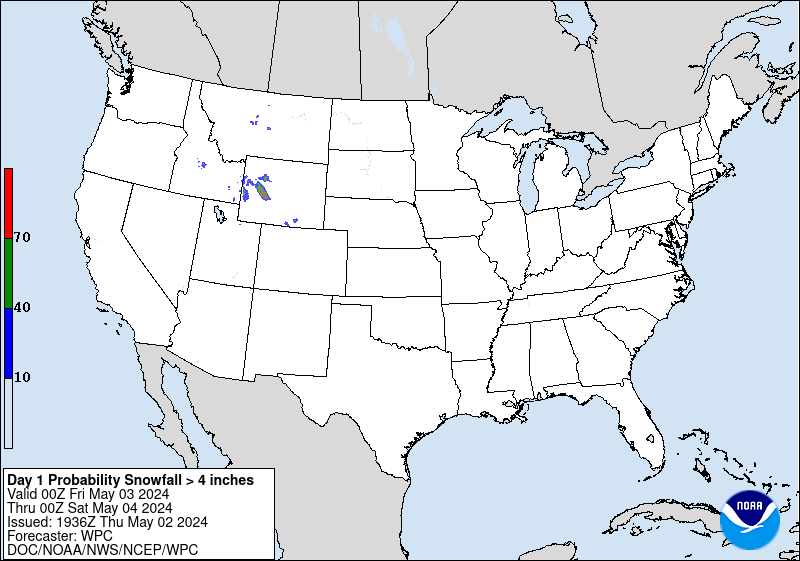
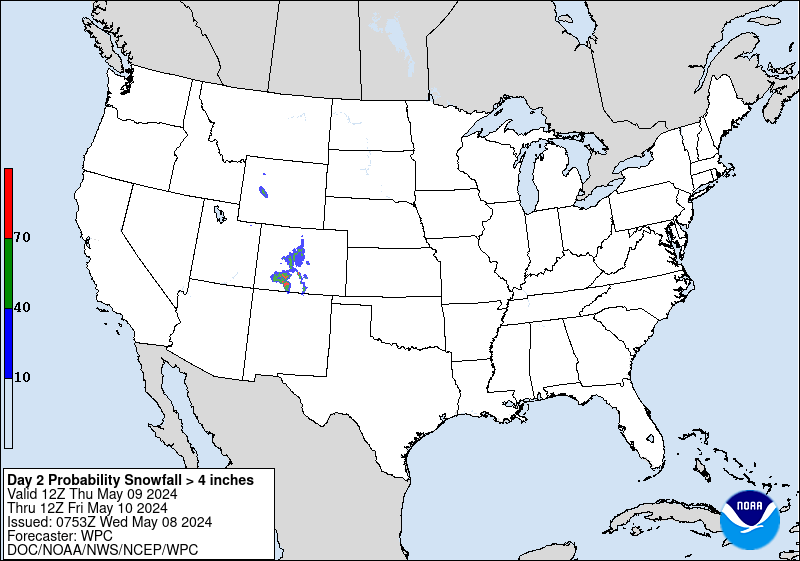
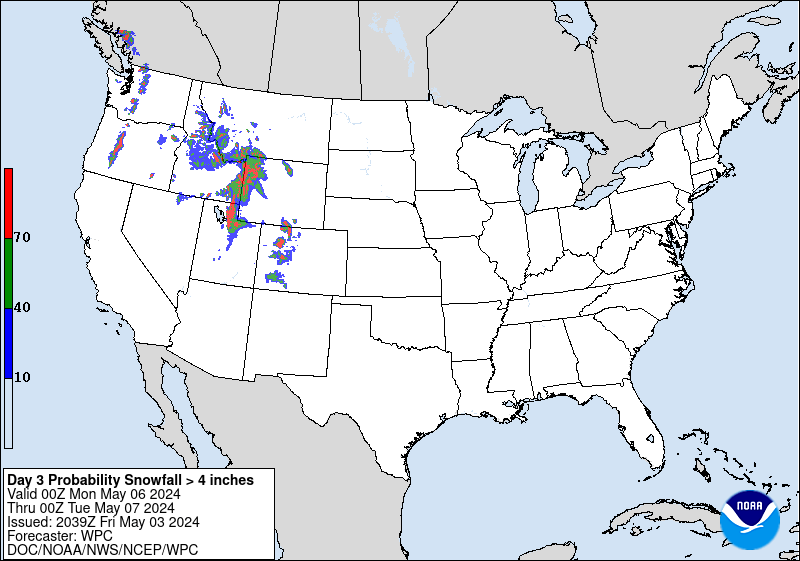
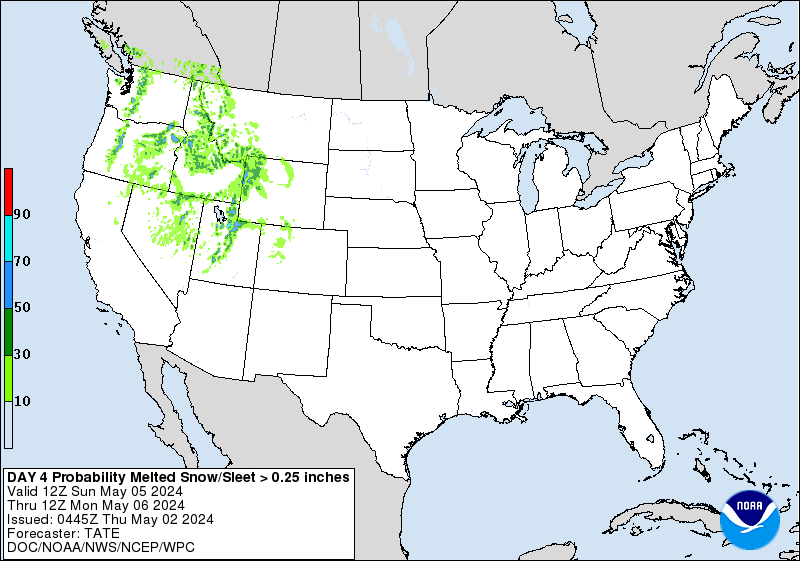
» Interactive Winter Weather Map (Day 1-3)
» Interactive Winter Weather Map (Day 4-7)
+ Forecast Discussion (Day 1-3)
Probabilistic Heavy Snow and Icing Discussion
NWS Weather Prediction Center College Park MD
124 PM EDT Thu Oct 15 2026
Valid 00Z Fri Oct 16 2026 - 00Z Mon Oct 19 2026
The probability of significant snow and ice across the CONUS is
less than ten percent
Snell
+ Additional Links
» Interactive Winter Weather Map (Day 4-7)
+ Forecast Discussion (Day 1-3)
Probabilistic Heavy Snow and Icing Discussion
NWS Weather Prediction Center College Park MD
124 PM EDT Thu Oct 15 2026
Valid 00Z Fri Oct 16 2026 - 00Z Mon Oct 19 2026
The probability of significant snow and ice across the CONUS is
less than ten percent
Snell
- » Product Verification
- » Product Archive
- » Product Info
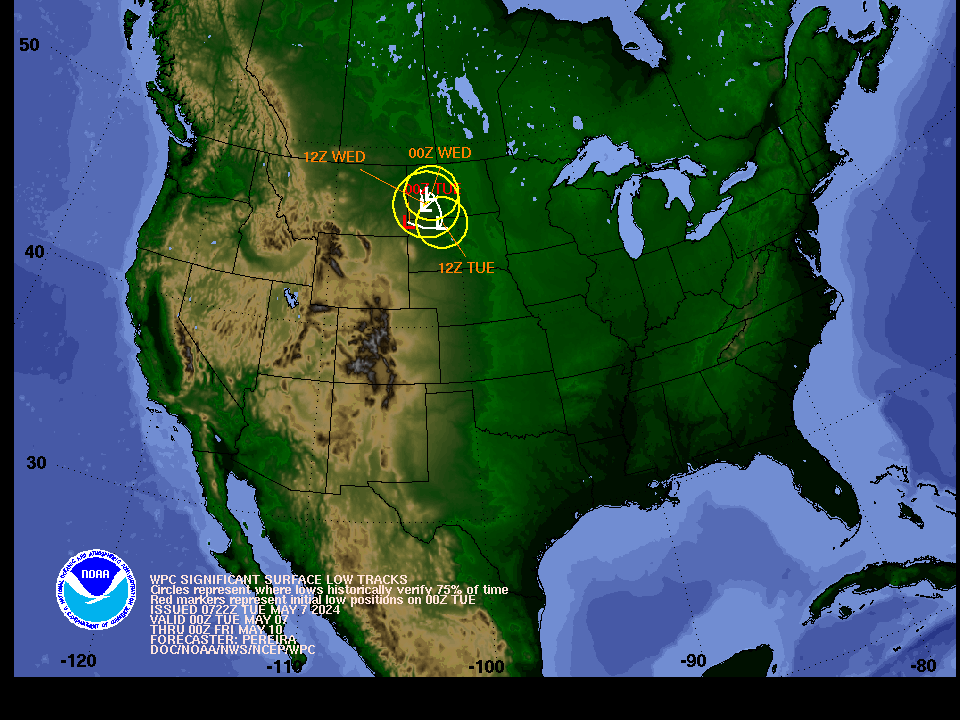
- » Forecast Surface Low Positions: Uncertainty Circles | Ensemble Clusters
- » Other Winter Weather Products
Medium Range Forecasts Legacy Page:
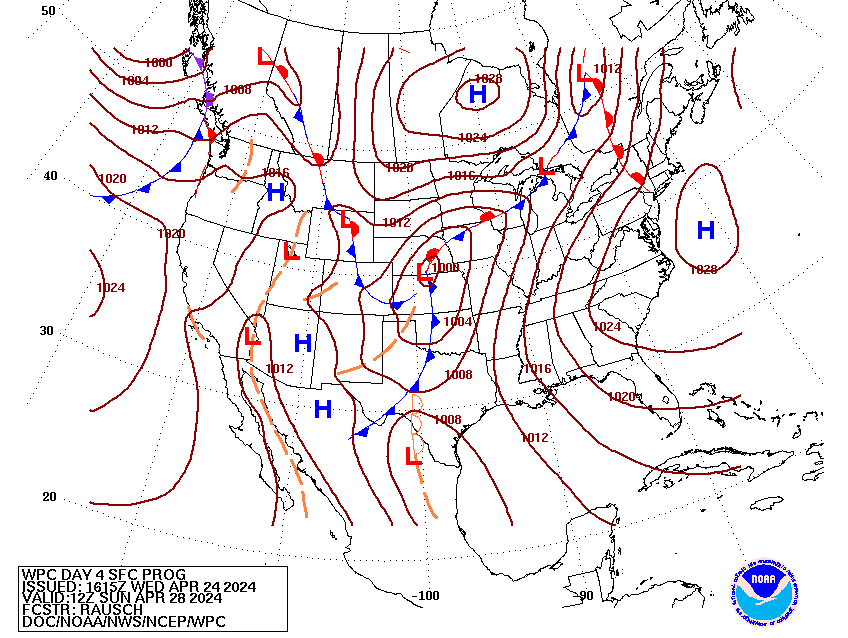
Valid 12Z Sun Oct 18, 2026
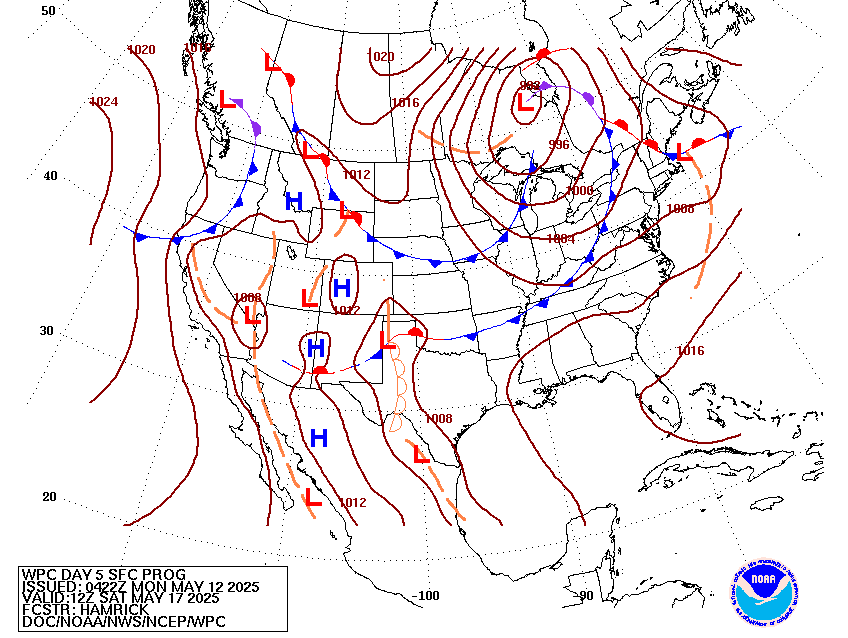
Valid 12Z Mon Oct 19, 2026
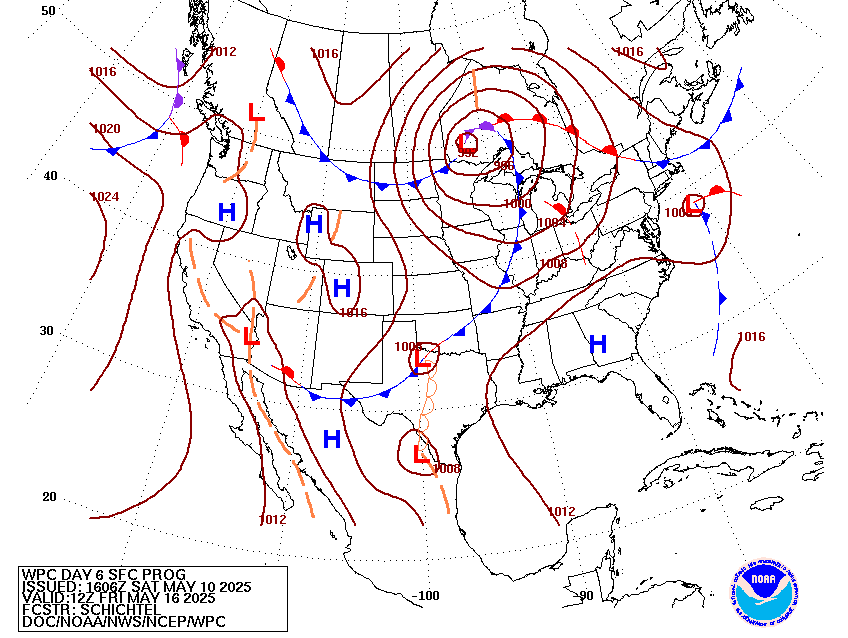
Valid 12Z Tue Oct 20, 2026
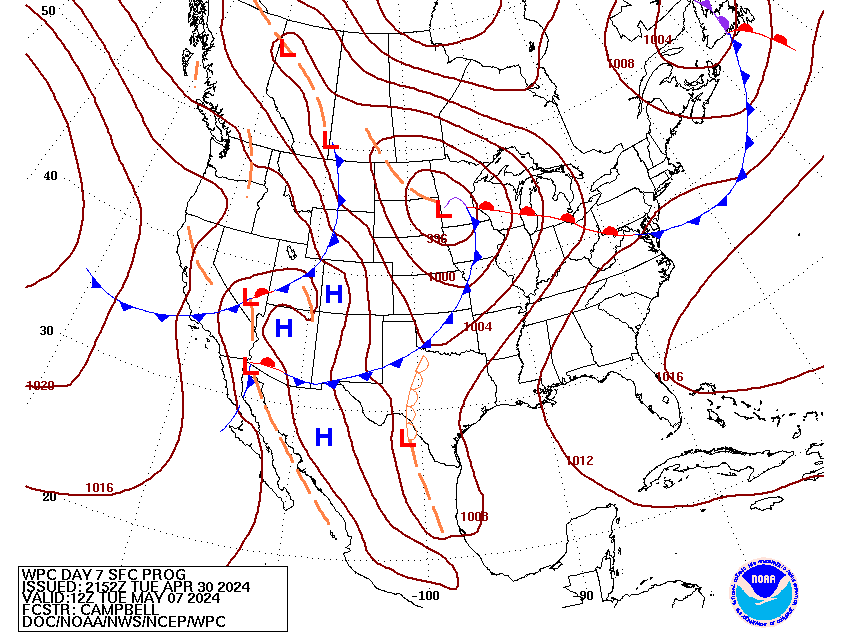
Valid 12Z Wed Oct 21, 2026
Valid 12Z Thu Oct 22, 2026
Image Options:
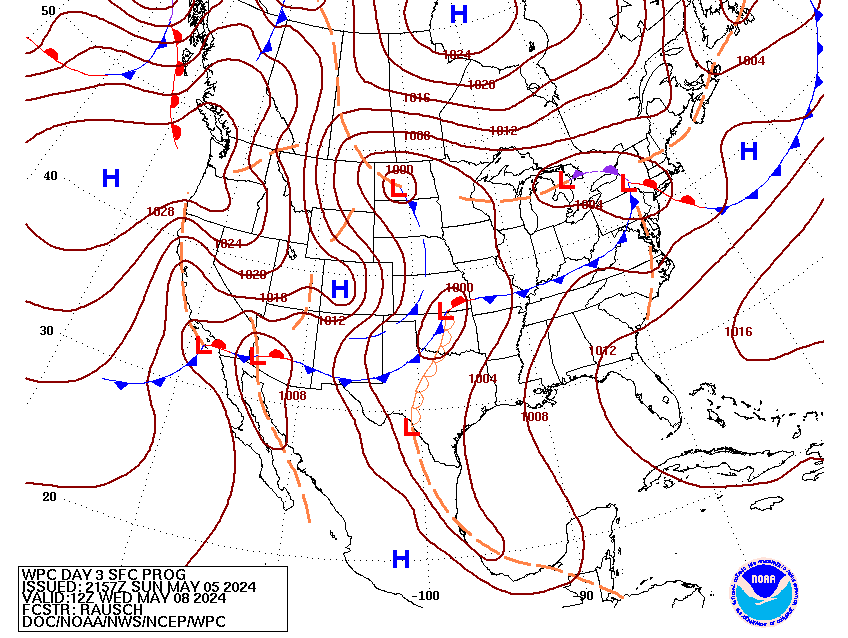
+ Forecast Discussion
+ Additional Links
Extended Forecast Discussion
NWS Weather Prediction Center College Park MD
412 PM EDT Thu Oct 15 2026

Valid 12Z Sun Oct 18 2026 - 12Z Thu Oct 22 2026


...Frost/freeze threats across parts of the Mid-Atlantic and
Northeast Sunday and Monday...

...A possible East Coast low early to mid next week could bring
coastal impacts...


...Overview...

A chilly surface high over the eastern U.S. will bring frost and
freeze concerns to parts of the Mid-Atlantic and Northeast early in
the period. A cold front sinking through Florida may bring a
threat for locally heavy rainfall on Sunday into Monday. There is
also increasing potential for a low pressure system to develop off
the East Coast along this front, which may bring coastal impacts
depending on how close to the coast the low gets. Out West, an
upper low will drop down the West Coast with deep troughing likely
over the West by next Thursday. This brings the potential for
widespread rain and high elevation snows especially Tuesday and
Wednesday next week, with some showers increasing across the
Central U.S. as well late period.


...Guidance/Predictability Assessment...

The latest model trends continue to favor the development of a low
pressure system somewhere off the Mid-Atlantic/Southeast coast in
the western Atlantic either later this weekend or early next week.
Despite these trends, uncertainty remains high as the location and
timing of development, degree of amplification, strength, and track
all remain in question. As a result, the WPC forecast utilized a
blend that tried to take a middle ground approach, while leaning
towards a more developed and relatively closer to the coast
solution. This ended up being primarily a non-NCEP consensus with
increasing weight on the EC ensemble mean beyond Day 5. Given the
potential for coastal impacts with a possibly stronger and closer
coastal low next week, model trends will need to be monitored in
the coming days as future forecast adjustments could be dramatic.

Out West, the latest guidance shows better agreement with the
evolution of an upper trough that drops southward along the coast
and eventually closes off into a closed low over the Southwest late
this weekend into next week. The slower and more amplified
solutions are looking more likely to verify, which will result in a
slower progression of inland penetration of precipitation and a
generally warmer system evolution featuring mostly rain and only
high elevation snow above 9000-10000 feet.


...Weather/Hazards Highlights...

A cold front moving slowly southward through Florida will allow
for increased onshore flow and locally heavy rainfall, especially
along the East Coast. WPC has this region in a marginal risk for
Sunday. Coastal low pressure development off the Mid-Atlantic coast
may allow for more showers and locally heavy rainfall for the
eastern Carolinas and southeast Virginia, with possible gusty
winds; however, concerns for coastal impacts are all highly
dependent on how close to the coast this low forms, which is still
high uncertain. A closer low would mean much greater impacts (high
winds, rough surf, coastal flooding, etc), especially if the low
lingers for any period of time. Out West, precipitation chances
increase by Monday and especially Tuesday into Wednesday with rain
and high elevation snow. Some rainfall may begin to develop across
the south-central U.S. by mid next week as well.

Canadian high pressure will be in place across much of the East on
Sunday, with frost/freeze concerns for parts of the Mid-Atlantic
and the Northeast. Elsewhere, above normal temperatures will expand
across the Central U.S. as conditions trend cooler across the West
underneath deep troughing next week.


Miller/Santorelli


Additional 3-7 Day Hazard information can be found on the WPC
medium range hazards outlook chart at:
https://www.wpc.ncep.noaa.gov/threats/threats.php

WPC medium range 500mb heights, surface systems, weather grids,
quantitative precipitation forecast, excessive rainfall outlook,
winter weather outlook probabilities, heat indices and Key Messages
are at:

https://www.wpc.ncep.noaa.gov/medr/5dayfcst500_wbg.gif
https://www.wpc.ncep.noaa.gov/medr/5dayfcst_wbg_conus.gif
https://www.wpc.ncep.noaa.gov/5km_grids/5km_gridsbody.html
https://www.wpc.ncep.noaa.gov/qpf/day4-7.shtml
https://www.wpc.ncep.noaa.gov/#page=ero
https://www.wpc.ncep.noaa.gov/wwd/pwpf_d47/pwpf_medr.php?day=4
https://www.wpc.ncep.noaa.gov/heat_index.shtml
https://www.wpc.ncep.noaa.gov/#page=ovw
Warning: include(tools_test.php): Failed to open stream: No such file or directory in /data/public/para/para_includes/productdisplay_test.php on line 84
Warning: include(): Failed opening 'tools_test.php' for inclusion (include_path='.:/usr/share/pear:/usr/share/php') in /data/public/para/para_includes/productdisplay_test.php on line 84