Excessive Rainfall Discussion
NWS Weather Prediction Center College Park MD
850 PM EDT Sun Apr 26 2026
Day 1
Valid 01Z Mon Apr 27 2026 - 12Z Mon Apr 27 2026
...THERE IS A SLIGHT RISK OF EXCESSIVE RAINFALL IN THE CENTRAL
PLAINS...
...01Z Update...
Few changes needed to the Excessive Rainfall Outlook based on short
term radar or satellite trends and a quick look at the latest
guidance. One change was another southeastward expansion of the
Slight Risk area based on the trends shown by the last several runs
of the HRRR. The HRRR continues to show additional convection
across eastern Kansas later...presumably once the low level jet
develops. As a result...left the area in a Slight Risk. This area was
also in line with where the UKMET had its axis of heaviest
precipitation...although thinking in the areal coverage of high
amounts is on the high side.
Bann
...2139Z Special Update... Given trends seen in short term radar
and satellite imagery about where convection initiated and its
movement east-southeastward into better instability and
inflow...amended the previous Excessive Rainfall Outlook by
expanding the Slight Risk area deeper into Missouri. By doing
that...there was better overlap with the HRRR guidance that has
shown growing areal coverage and rainfall amounts. Given the run to
run variability...confidence not strong enough to expand farther
south and east but it may become clearer by the 01Z Update. MPD
0135 was valid for portions of the area through 27/0258Z.
Bann
...16Z Update...
Few changes were needed to the inherited ERO risk areas across the
Central Plains for today and tonight. The high resolution CAMs
guidance has generally remained set on far northeast Kansas and
northwestern Missouri for the greatest likelihood of seeing
training storms with a developing MCS this evening into tonight.
That said, the details of exactly where the heaviest rains occur
remains highly uncertain, with each CAMs model showing a different
outcome. While unusual, considering the fast-evolving nature of
most MCSs and the fact that this one has yet to develop, it's not
surprising to still have this much uncertainty less than 12 hours
out. Nonetheless, some of the guidance shows the heaviest rains
focused in Nebraska and Iowa, while others focus much further south
into the Kansas City metro. Thus, the ongoing ERO risk areas still
highlight the "middle ground" of the guidance. Users should note
that due to the high uncertainty, that significant changes may be
needed once the storms start to fire later today, both in the
upgrade direction along the swath of heaviest rains and training
storms, and also in the downgrade direction in the areas where it
becomes clear little to no rain will occur.
A small north and west expansion was made to the Slight Risk area
into Nebraska and Kansas with this update, reflecting a plurality
of the CAMs guidance focusing the heaviest rains a bit more to the
north and west. Meanwhile the Marginal was expanded a bit to the
south in Kansas and Missouri to reflect the typical southward
drift in the guidance when depicting convective development, and to
reflect some of the uncertainty with the southward-favoring
guidance, such as the HRRR. The Marginal was also expanded
northeast into northeastern Iowa with the latest 12Z HREF suite
highlighting potential FFG exceedance after midnight tonight.
Further, the 12Z HREF suite highlighted a portion of Arkansas for a
thunderstorm cell or two moving southeast through a more
hydrologically sensitive area, so the Marginal was expanded there
as well.
Wegman
...Previous Discussion...
The latest hi-res model guidance has trended substantially toward
a corridor of heavy rainfall in the Central Plains this evening and
tonight. Therefore, confidence has increased in a heavy rain event,
but considerable uncertainty still remains on the location. Some
guidance places the heaviest rain almost wholly into Iowa, while
other guidance is further south in the vicinity of the I-70
corridor in Kansas and Missouri -- almost 200 miles of variability
with approximately 18 hours of lead time. Given the consistent
signal for significant rainfall, we have upgraded to a Slight Risk,
and drawn it broadly to account for positional uncertainty. The
contours were largely based on EAS probabilities from the 00Z HREF;
and the major axis of the Slight Risk area intersects the QPF
maximum on the AI versions of the GFS and GEFS.
Convection is expected to develop this afternoon on the nose of a
strengthening low-level jet (LLJ) and plume of instability, likely
in northern Kansas or southeast Nebraska initially. The convective
evolution in the approx. 6 hours after initiation will be
important. In general, all models show a west-to-east progression
of thunderstorm clusters, consistent with the bulk shear vectors,
and along a focused area of low-level convergence near the nose of
the LLJ. Some models show scattered clusters progressing over
similar areas, but with intermittent breaks and not precise
training; others show a more continuous band of convection training
in a specific corridor (sustaining 1-2 inch per hour rain rates for
several hours in a given location). Comparing QPFs from those
scenarios suggests the latter scenario could double rainfall, with
amounts potentially high enough to lead to significant flash
flooding. Therefore, this will need to be monitored closely.
A Marginal Risk was considered in the Arklatex region as ongoing
convection will likely persist in some form beyond 12Z. However, a
squall line in southern Arkansas appears to be forward propagating
and accelerating, if anything. And other thunderstorm activity is
more isolated and generally less intense. Therefore, a non-zero
excessive rainfall risk does exist in the region, but no Marginal
Risk was outlined at this time.
Lamers
Day 1 threat area:
www.wpc.ncep.noaa.gov/qpf/94epoints.txt
Excessive Rainfall Discussion
NWS Weather Prediction Center College Park MD
850 PM EDT Sun Apr 26 2026
Day 2
Valid 12Z Mon Apr 27 2026 - 12Z Tue Apr 28 2026
...THERE IS A SLIGHT RISK OF EXCESSIVE RAINFALL FOR PORTIONS OF
THE MIDWEST...
...2030Z Update...
The inherited Slight Risk was shifted well to the south and east
with this update, to include most of Illinois, Indiana, and a
portion of western and central Kentucky. While many of these areas
have been very dry lately, a stream of deep Gulf moisture will
advect north into the area on and LLJ featuring 60+ kt winds at
850 mb and PWATs potentially exceeding 1.75 inches in the Slight
Risk area Monday night. MUCAPE values anywhere from 1,500 to 2,500
J/kg is plenty of needed instability to support storms growing to
heights capable of producing heavy rain. Thus, while any severe
storms may be progressive in the form of a line over portions of
this area, that kind of moisture, any trailing segments, and the
antecedent dry soils could work to increase the flash flooding
risk. Anywhere soils have hardened due to the recent drought will
make the onset of heavy rain convert nearly all of the rain to
runoff. Some of the guidance, especially the HRRR, shows that late
tonight, the southern end of the line across Tennessee may hang up
due to the strength of the LLJ pushing against the southward
progressing line of storms. Then on the northern end, from Chicago
north, areas north of the greatest eastward progression of the
storms will also have a greater chance of hanging up and training
from southwest to northeast.
The greatest threat of flash flooding will be in urban areas of the
Slight risk such as Chicago, Indianapolis, and St. Louis. The
Slight Risk may need to be expanded further south across Tennessee
to include Nashville and Memphis if the front progresses faster
than expected. Otherwise, the Slight Risk for Day 3 for that region
covers expected lingering convection in Tennessee and points south
into Tuesday morning. Across Minnesota and Wisconsin, the Marginal
Risk was expanded in coordination with DLH/Duluth, MN forecast
office. Recent heavy rains across the upper Midwest have left soils
more vulnerable to flash flooding, despite less intense rainfall
expected due to lack of instability.
Wegman
...Previous Discussion...
The training band of convection from Sunday Night is likely to
progress eastward into the Midwest on Monday; placement
uncertainties grow on Day 2, but there has been a general southward
shift in the location of the heaviest rainfall in model guidance
over the last couple cycles. Some guidance now shows the corridor
of heaviest rainfall on Monday and Monday Night as far south as the
I-70 corridor from St. Louis to Indianapolis, while other guidance
remains closer to the Illinois-Wisconsin border, where the existing
Slight Risk area was concentrated. This is about a 200 mile spread.
So while heavy rainfall is expected, confidence remains somewhat
low on the location. Given the overall trends, the main change was
to shift the axis of the Slight Risk southward, albeit only about
70 miles out of deference to continuity.
The overall environment will be very supportive of heavy rain
rates. A plume of 1.2 to 1.7 inch PWs (above the 95th percentile
for late April) and moderate to strong instability will support 1
to 2 inch rain rates in organized convective clusters and lines.
Although training convection may continue into Monday morning,
convective lines should become oriented more in a north-south
fashion later in the day as forcing along an accelerating cold
front increases. The best opportunity for training convection, and
therefore a longer duration of heavy rain rates, should be in or
near the Slight Risk area. Areas further south should not only see
steady progression to any convective lines, but have also been much
drier lately, so the risk of flash flooding is lower despite some
similar QPF from the latest model guidance.
Lamers
Day 2 threat area:
www.wpc.ncep.noaa.gov/qpf/98epoints.txt
Excessive Rainfall Discussion
NWS Weather Prediction Center College Park MD
850 PM EDT Sun Apr 26 2026
Day 3
Valid 12Z Tue Apr 28 2026 - 12Z Wed Apr 29 2026
...THERE IS A SLIGHT RISK OF EXCESSIVE RAINFALL FOR PORTIONS OF THE
MID-SOUTH...
...2030Z Update...
A weak area of low pressure, forming on a jet streak and rather
weak upper level shortwave in the upper levels, and downwind of a
pressure ridge of cooler air over Oklahoma, will push east across
the Mid-South on Tuesday. As it moves, it will run into a plume of
deep Gulf moisture across Texas and the mid-South. The uplift of
the cooler air, upper level support, deep moisture and instability,
will lead to robust thunderstorm formation across Arkansas and far
northern Louisiana. The storms associated with this front will
merge with a stalled front that led to shower and thunderstorm
formation further north on Monday. This line of storms is likely to
form in northern Arkansas, then push south across western
Tennessee, northern Mississippi, and northern Alabama. The merger
of these two lines of storms and their associated fronts will
likely result in areas of training along the frontal interface.
Deep Gulf moisture supported by a 30-40 kt low level jet will
support backbuilding and further thunderstorm development behind
the leading line of storms. PWATs could approach 2 inches in some
areas.
Hydrologically, western Tennessee especially has been very dry with
surface soil moisture levels less than 2% of normal. While for most
areas this will likely help mitigate any flooding concerns, the
potential for training storms capable of rainfall rates to 3 inches
per hour will likely overwhelm local drainage basins where those
rates can materialize, regardless of the prior dry conditions.
Thus, a Slight Risk upgrade was hoisted to account for the very
favorable meteorology (strong storms capable of multiple inch/hour
rates, training, and a steady supply of deep tropical Gulf
moisture), which can overcome very unfavorable hydrology. Flash
flooding is most likely where ever these heavy rainfall rates occur
over urban or more flood sensitive areas. Further south into
Mississippi, more recent rainfall has made a few areas have above
normal soil moisture levels for this time of year, with many areas
around or slightly below normal.
Wegman
Day 3 threat area:
www.wpc.ncep.noaa.gov/qpf/99epoints.txt
Extended Forecast Discussion
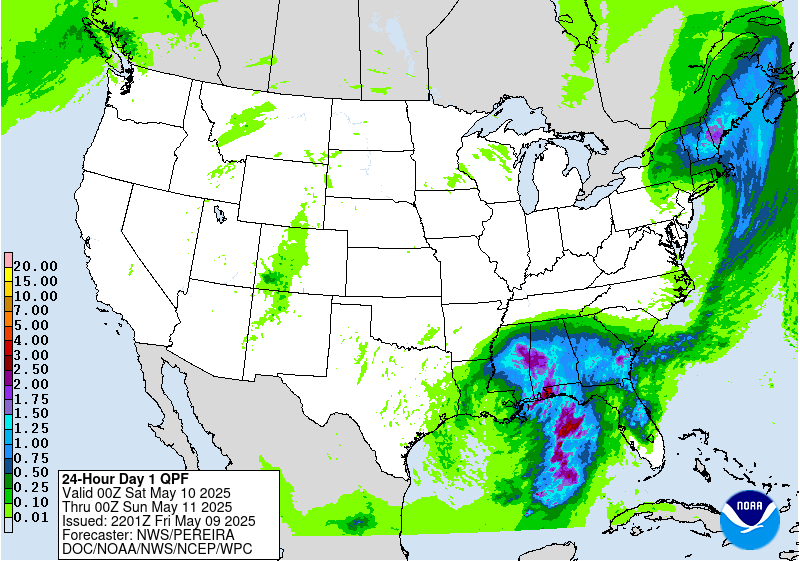
NWS Weather Prediction Center College Park MD
236 PM EDT Sun Apr 26 2026
A frontal wave will lay a front across The South near the Gulf
Coast Wednesday, providing the focus for additional afternoon and
evening showers and thunderstorms. Some of this activity may
contain heavy rainfall rates given adequate moisture and
instability, but any flooding concerns should remain localized.
Thus, a null Day 4/Wednesday Excessive Rainfall Outlook (ERO) is
maintained with this forecast update. The aforementioned frontal
wave will track off the Mid-Atlantic coast Wednesday into
Thursday, spreading much needed rainfall to much of the eastern
U.S. By the end of the week, a growing signal for deeper coastal
low development and anomalous long-fetch Gulf/Atlantic moisture
wrapping into New England will support a heavy rain threat with the
potential for 1-3"+ of rainfall. While the signal for heavy rain
is noteworthy and could lead to runoff or localized poor drainage
flooding, recent moderate to severe drought conditions may render
most of the rain more beneficial than hazardous. As a result, no
Day 5/Thursday ERO was highlighted for the time being. The coastal
low stalls out later Friday into the weekend, allowing intensity
to wane but keeping conditions cool, windy, and wet/unsettled. A
little wrapping snow can't be ruled out either across the higher
elevations of northern New England or the Interior Northeast.
Meanwhile, a southern stream Pacific low will slowly track inland
across southern California, the Southwest, and the Four Corners
states Wednesday into Thursday, spreading light to moderate low
elevation rain and higher elevation mountain snow into the region.
As this feature ejects eastward into the southern Plains, another
growing signal for significant rainfall develops and
expands/strengthens over the south-central U.S. Thursday into
Friday. Anomalous Gulf moisture overrunning a lingering frontal
boundary combined with impressive dynamics and forcing from a
strong upper jet will lead to the potential for rainfall totals of
1-3"+ across the heart of Texas. Despite questions with respect to
the quality of instability (particularly with northward extent) and
the ongoing drought conditions over parts of the region, the heavy
rain signal is concerning enough for a Marginal Risk ERO for
runoff/isolated flooding issues Day 5/Thursday. Waves along the
frontal zone will expand the rainfall footprint eastward over the
Mid-South and Southeast Friday into the weekend, with additional
risks of heavy rain/runoff issues to be monitored.
Miller/Schichtel
Extended Forecast Discussion
NWS Weather Prediction Center College Park MD
236 PM EDT Sun Apr 26 2026
A frontal wave will lay a front across The South near the Gulf
Coast Wednesday, providing the focus for additional afternoon and
evening showers and thunderstorms. Some of this activity may
contain heavy rainfall rates given adequate moisture and
instability, but any flooding concerns should remain localized.
Thus, a null Day 4/Wednesday Excessive Rainfall Outlook (ERO) is
maintained with this forecast update. The aforementioned frontal
wave will track off the Mid-Atlantic coast Wednesday into
Thursday, spreading much needed rainfall to much of the eastern
U.S. By the end of the week, a growing signal for deeper coastal
low development and anomalous long-fetch Gulf/Atlantic moisture
wrapping into New England will support a heavy rain threat with the
potential for 1-3"+ of rainfall. While the signal for heavy rain
is noteworthy and could lead to runoff or localized poor drainage
flooding, recent moderate to severe drought conditions may render
most of the rain more beneficial than hazardous. As a result, no
Day 5/Thursday ERO was highlighted for the time being. The coastal
low stalls out later Friday into the weekend, allowing intensity
to wane but keeping conditions cool, windy, and wet/unsettled. A
little wrapping snow can't be ruled out either across the higher
elevations of northern New England or the Interior Northeast.
Meanwhile, a southern stream Pacific low will slowly track inland
across southern California, the Southwest, and the Four Corners
states Wednesday into Thursday, spreading light to moderate low
elevation rain and higher elevation mountain snow into the region.
As this feature ejects eastward into the southern Plains, another
growing signal for significant rainfall develops and
expands/strengthens over the south-central U.S. Thursday into
Friday. Anomalous Gulf moisture overrunning a lingering frontal
boundary combined with impressive dynamics and forcing from a
strong upper jet will lead to the potential for rainfall totals of
1-3"+ across the heart of Texas. Despite questions with respect to
the quality of instability (particularly with northward extent) and
the ongoing drought conditions over parts of the region, the heavy
rain signal is concerning enough for a Marginal Risk ERO for
runoff/isolated flooding issues Day 5/Thursday. Waves along the
frontal zone will expand the rainfall footprint eastward over the
Mid-South and Southeast Friday into the weekend, with additional
risks of heavy rain/runoff issues to be monitored.
Miller/Schichtel