Excessive Rainfall Discussion
NWS Weather Prediction Center College Park MD
401 PM EDT Tue Oct 13 2026
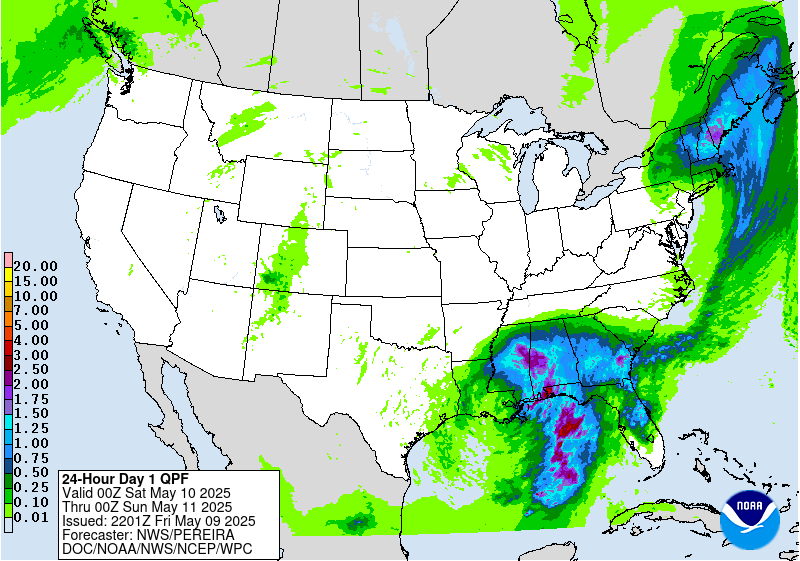
Day 1
Valid 16Z Tue Oct 13 2026 - 12Z Wed Oct 14 2026
...THERE IS A SLIGHT RISK OF EXCESSIVE RAINFALL ACROSS PARTS OF
THE CENTRAL AND SOUTHERN PLAINS INTO THE LOWER MISSOURI VALLEY...
16Z Update...
Added a small Marginal Risk area over southeast Texas and adjacent
portions of Louisiana...mainly for the afternoon hours. Main
concern is the high precipitable water values...around 2
inches...combined with confluent flow straddling the Louisiana and
Texas border region. CAPE values along and ahead of that confluent
flow should peak around 1500 J per kg. 12Z runs of the HRRR and
RRFS both highlight this region as having at least a low end threat
of 1 to 2 inch per hour rainfall accumulations. The high flash
flood guidance in the region suggests that the risk is more in
regions of poor drainage and in urban areas.
Elsewhere...the latest guidance still supports the placement of the
previously issued Slight risk area. The expectation is that this
risk develops later today and tonight.
Bann
Previous Excessive Rainfall Outlook...
Longwave pattern across the Central and Southern U.S. will
materialize in such that a broad convective evolution is
increasingly favorable for the late-afternoon hours, carrying into
Wednesday morning for the D1. The western ULL currently analyzed
over northern Nevada will slowly pivot southeastward towards the
UT/AZ border by the afternoon with increasingly diffluent flow
positioned across the Central Plains and portions of the Southern
High Plains as we move into the second half of the D2. A broad
upper jet alignment will arc over the the northern tier of the
CONUS leading to a well placed RER jet core centered over the
Central U.S. with the ascent maximized likely south of a latitude
of I-80. Current surface analysis indicates the development of a
weak lee side surface reflection over the Front Range of Colorado
with a defined cold front extending through the Central Plains
around southern NE into IA. Expectation is for these features to
exhibit very little forward propagation from their initiation
points as the pattern out west evolves very slowly. Additional
input of energy streaming poleward out of the Eastern Pacific, up
through Mexico, and into the High Plains will occur in tandem with
the overall longwave evolution as energy on the northern edge of
Hurricane Simon will advance north- northeast into the region
around the western periphery of a broad ridge centered over the
Lower Mississippi Valley. The ample ascent provided by both mid-
level vorticity advection and improving large scale jet dynamics
within deep layer moisture presence over the Plains will aid in the
production of convection as we step into the peak diurnal
instability hours, and beyond.
The setup also calls for an integration of a LLJ development
around sunset (00z Wednesday), which will only act as a convergent
piece of this puzzle as the addition of low- level southerly
enhancement will only act to assist the convective pattern with
increasing low- level shear and maintenance of general buoyancy
across the Plains. This general positive feedback mechanism will
allow for a maturation of area convection over the Central Plains
and Mid- Mississippi Valley, eventually back into the Southern High
Plains. Model consensus indicates a blossoming of convective
coverage across KS/MO/OK/west TX between 21-00z with an expected
initiation of convection thanks to the LLJ interaction with the
streaming mid- level energy ejecting out of Mexico. Generally slow
cell motions and potential for repeating convection are anticipated
over the entire stretch from southwest TX up through the Central
Plains with the latest forecast soundings across the South-Central
U.S. indicative of weakening mean winds and backing of the low-
level flow that would support some back- building potential of
precipitation in-of OK/KS into western MO. As of this time, the
relative FFG's in the area would support at least the initial
threat of heavy rainfall as current QPF means hover between 1-2"
over a broad area from the Permian Basin up into eastern KS and
adjacent western MO. Deterministic outputs do signal some local
totals >3" across portions of the aforementioned area with
agreement from the latest 00z HREF neighborhood probabilities
signaling 20-40% probs for >3" over the Southern High Plains and
35-60% situated over eastern KS into the Lower Missouri Valley
centered near Kansas City. This would place a majority of areas
between west TX into MO near the 3 and 6hr FFG thresholds in place
leading to modest FFG exceedance probs with the current QPF outputs.
Considering the current signals within both the probability fields,
as well as the forecasted environment and expected synoptic
evolution, there was enough to drive an addition of a broad SLGT
risk from the Pecos River Valley to points northeast into the Lower
Missouri Valley. The greatest threat will likely lie within the
Permian Basin and neighboring Caprock, as well as the Central
Plains and Lower Missouri with emphasis on eastern KS into adjacent
areas of MO. This will be the beginning of a long period of
unsettled weather for many in this zone with multiple days of heavy
rainfall possible for some.
Kleebauer
Day 1 threat area:
www.wpc.ncep.noaa.gov/qpf/94epoints.txt
Excessive Rainfall Discussion
NWS Weather Prediction Center College Park MD
401 PM EDT Tue Oct 13 2026
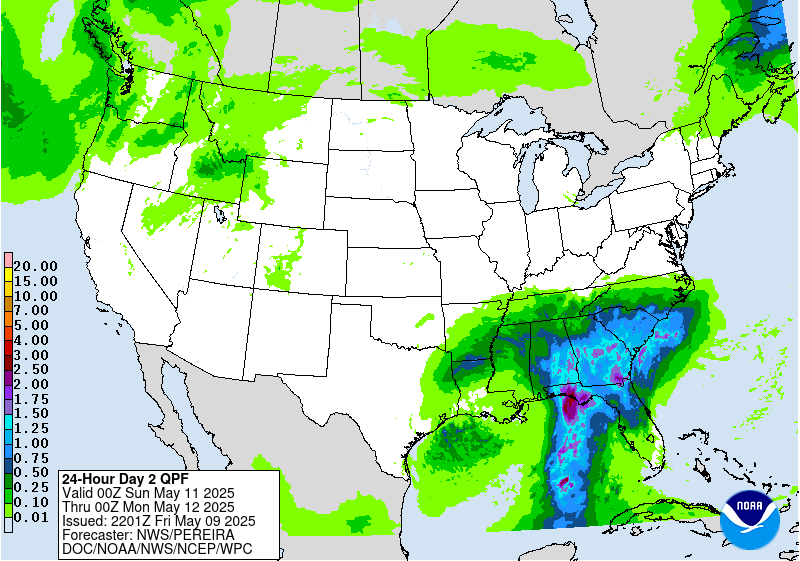
Day 2
Valid 12Z Wed Oct 14 2026 - 12Z Thu Oct 15 2026
...THERE IS A SLIGHT RISK OF EXCESSIVE RAINFALL ACROSS PORTIONS OF
THE SOUTHERN HIGH PLAINS INTO THE CENTRAL PLAINS, AND THE MID-
MISSISSIPPI AND OHIO VALLEYS...
2030Z Update...
The region from the southern/western Great Lakes to the
international border in southwest Texas remains in a region of deep
moisture transport being located between an upper low/broad trough
to the west and upper ridge to the east. Little has changed in the
big picture since the previous outlook so changes were minor.
Bann
Previous Excessive Rainfall Discussion...
A generally classic setup for persistent heavy rainfall will
materialize over the Central and Southern U.S. come mid-week with a
vast, arcing jet situated from the Central Rockies to the Canadian
Maritimes. At the surface, a slow-moving area of low pressure with
attendant frontal alignments on both the eastern and southern flank
of the surface center will meander over the Front Range and Central
Plains with the cold front at the trough base making headway
through the Southern Rockies into the Southern High Plains by the
end of the forecast cycle with a press of Pacific air in wake of
the front. The front over the Southwest is anticipated to lose some
steam in its progression to the east leading to less propulsion
into the High Plains, but enough to garner at least another viable
region of convergence across far west TX up through the Caprock of
TX. Further north, the front in question will become more quasi-
stationary with its forward propagation likely coming from local
outflows and the leading edge of the pressure gradient caused by a
strengthening areas of surface high pressure over the Northern
Plains. As our upper level disturbance makes its advancement into
the Central Rockies on Wednesday evening, we'll finally see the
overall pattern begin to exhibit more motion with front over the
Plains being pushed south with the surface ridge to the north
shifting eastward into the Great Lakes and strengthening slowly
thanks to the evolution of the upstream upper level pattern.
The combination of large scale ascent situated under a broad RER
of a prolific upper jet along with ample moisture advected up out
of the Gulf and from some of the remnants of now Hurricane Simon
being pulled poleward will create a broad convective regime with
general QPF maxima occurring during peak diurnal instability and
overnight when the nocturnal LLJ initiates over the Plains. There
continues to be excellent consensus among all guidance, including
the latest CAMs this evening, for a prolonged heavy rain event
from southwest TX up through the Mid-Mississippi Valley, arcing as
far east as the Ohio Valley along the front positioned on the
leading edge of a strong surface high moving over the northern tier
of the CONUS. Forecast PWAT anomalies maintain a consistent
depiction among both the deterministic and ensemble based outputs
with the latter converging on a widespread area of +2 to +3
standard deviations over much of the Central and Southern U.S. into
the western Ohio Valley. The latest CAMs are ripe with a large
area of convective coverage throughout the D2 over this broad
expanse of the CONUS as the upper level projection maintains such a
stable presence of robust upper forcing with the upper jet fixed
over the same area for at least 36-48 hrs. This has led to signals
for 1-2" rainfall potential with locally higher inputs within the
deterministic across the Ohio Valley into the Mid-Mississippi area,
and closer to 2-3" means across the Southern Plains back into west
TX where the greatest instability, deep layer moisture presence,
and added mid-level energy advection are co-located for the setup.
Just based off the first 12 hrs in the forecast cycle (12z Wed -
00z Thu), the 00z HREF neighborhood and EAS probabilities signal
modest threats for totals >2" with a core of relevant >3" probs
located across western OK down into the Red River area along the
TX/OK border. This is prior to even the threat that will occur in
the evening with the additional LLJ presence that will surely prop
up the convective potential and allow for prolonged spells of
heavy rainfall along and ahead of the quasi-stationary front turned
cold front Wednesday night into Thursday morning. Areas from west
TX up through OK into the Ozarks are likely to be the beneficiaries
from this evolution as the front becomes a focal point for
convection, and will continue to be the case as we move into the
new D3. The previous SLGT risk was not only maintained, but
expanded further east into the Central and Southern Ohio Valley
with an emphasis along the Ohio River basin where models are keen
to heavy precip prospects during the afternoon and evening hours
Wednesday. The SLGT expands through much of the South-Central
Plains, and back into the Southern High Plains where scattered
thunderstorms with heavy rainfall are increasingly likely come
Wednesday evening as the environment remains buoyant and
sufficiently moist for stronger convective cores capable of rates
>2"/hr at times.
Kleebauer
Day 2 threat area:
www.wpc.ncep.noaa.gov/qpf/98epoints.txt
Excessive Rainfall Discussion
NWS Weather Prediction Center College Park MD
401 PM EDT Tue Oct 13 2026
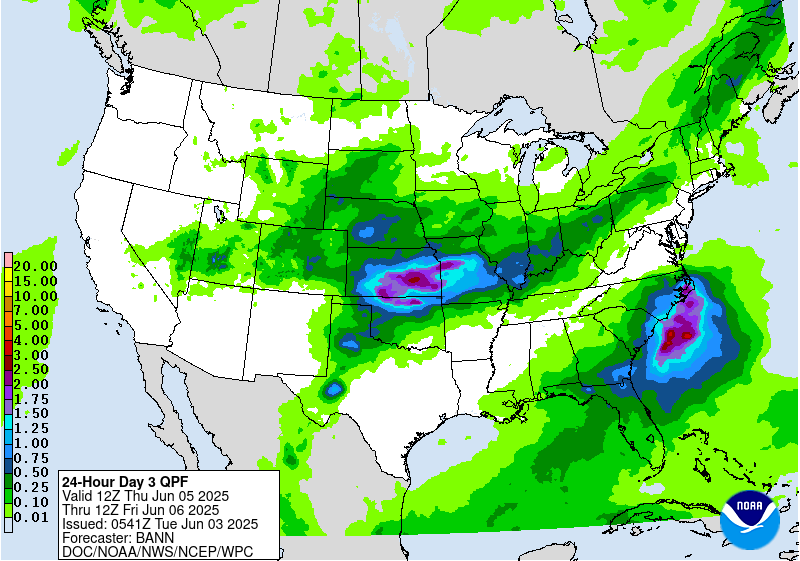
Day 3
Valid 12Z Thu Oct 15 2026 - 12Z Fri Oct 16 2026
...THERE IS A SLIGHT RISK OF EXCESSIVE RAINFALL ACROSS PORTIONS OF
THE SOUTHERN HIGH PLAINS INTO THE CENTRAL PLAINS AND LOWER MISSOURI
VALLEY...
2030Z Update...
Except for a slight southward shift of the SLight Risk area in
southwestern Texas that was driven by subtle changes in the
deterministic QPF...the changes made to the Excessive Rainfall
Outlook were minor.
Bann
Previous Excessive Rainfall Discussion...
The second half of the week will feature quite the large scale
shift in the pattern as our cold front to the north will make
steady progress southward through the period with a strong push
from a significant area of surface high pressure originating out of
Canada. The upper pattern will finally see our western ULL
disturbance open back into a shortwave trough and eject east into
the Plains. To the north, a stout shortwave trough will pivot
southeast out of the Canadian Prairies with a robust mid-level
shortwave rounding the trough base and carving out significantly
lower heights over the Northern CONUS and points east. This
disturbance will merge with our shortwave over the Plains by
Friday morning generating a robust longwave trough to the east and
strengthening ridge along the Rockies leading to a stout surface
high migrating out of Canada by Thursday AM and beyond. This entire
upper level evolution will lead to our cold front being propelled
rapidly to the south after 00z Friday as diurnal mixing ceases and
the front faces little resistance on its push southward. The upper
level setup over the Southeast CONUS will still be in position to
provide a continued draw of rich theta_E air out of the Gulf into
the Southern Plains ahead of the front meaning the convergence
signature and prospects for heavy rainfall will continue for those
along and ahead of the front.
The greatest potential for heavy rain will exist over the Southern
High Plains into southwestern TX as they will be the last places to
see the frontal passage at any point in the forecast period with
areas of the Big Bend and Lower Trans Pecos likely to not see the
front until perhaps after the D3 time frame. General instability
maximum and PWAT anomalies up near +3 standard deviations correlate
to heavy thunderstorm prospects over the Southern High Plains with
a corridor of significant rainfall potential from the Western
Rolling Hills of TX, through the Permian Basin and Concho Valley,
down into the Big Bend area and over into the terrain of southwest
TX. Some added isentropic ascent will lead to prolonged periods of
heavy rain, even after the front passes until a more robust dry
air advection regime takes shape beyond the current D3. Totals
within ensembles are upwards of 2-4" across west TX with the max
focused over the Stockton Plateau towards the RGV within the Big
Bend. This setup resembles some of the more prominent heavy rain
depictions for west TX as the combination of pre-frontal convection
and then prolonged isentropically forced precipitation will
account for a cumulative effect, leading to such a robust QPF
depiction. This is trending towards a formidable setup for this
area of the CONUS with a high-end SLGT now forecast over the above
areas. There is a potential for an upgrade in the risk further, but
will wait to see if there are any timing changes with the front as
that could make a significant difference in the threat. For now,
the SLGT risk was deemed sufficient with assessment expected in
future updates.
Kleebauer
Day 3 threat area:
www.wpc.ncep.noaa.gov/qpf/99epoints.txt
Excessive Rainfall Discussion
NWS Weather Prediction Center College Park MD
401 PM EDT Tue Oct 13 2026
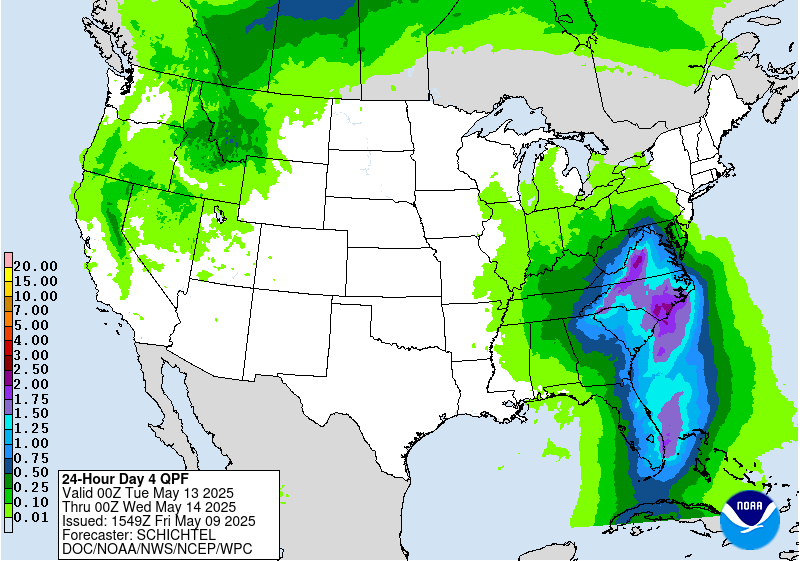
Day 4 and Day 5
Valid 12Z Fri Oct 16 2026 - 12Z Sun Oct 18 2026
...THERE IS A MARGINAL RISK OF EXCESSIVE RAINFALL ACROSS
PARTS OF SOUTHEAST FLORIDA SATURDAY AND SATURDAY NIGHT...
Day 5...
2000Z Update: The guidance has trended a bit more progressive with
the cold front on Saturday, which will considerably limit the
deep-layer instability (even elevated) north of the front across
east-central FL on Saturday. As a result of these trends, we have
now confined the Marginal Risk area south of the Space Coast and
much of the Treasure Coast. Continued onshore fetch (N-NE low-
level, post- frontal flow) will likely retard the negative PW
advection somewhat in areas behind (north of) the front, while the
strong 0-6km Bulk Shear (25+ kts) will also foster more organized
rain areas. However the sharply declining instability trends north
of the front will limit the short-term rainfall rate potential, and
as a result we've pared the Marginal Risk area to south of Vero
Beach, including the bulk of the Gold Coast and the metro/urbanized
areas within.
Hurley
Previous discussion..
A cold front is expected to press southward Saturday across central
to south Florida. In the wake of this front, low level east
northeasterly flow will strengthen into the east coast Florida. PW
values in this strengthening low level east northeasterly flow are
expected to remain above average, 1.5 to 2+ standard deviations
above the mean. Strong boundary layer convergence maxima likely
along the east central coast of Florida. This will support
potential for locally heavy rains from well defined rain bands that
may train for a period, with isolated runoff issues possible along
the east central coast of Florida, especially in urbanized
regions.
Oravec
Excessive Rainfall Discussion
NWS Weather Prediction Center College Park MD
401 PM EDT Tue Oct 13 2026
Day 4 and Day 5
Valid 12Z Fri Oct 16 2026 - 12Z Sun Oct 18 2026
...THERE IS A MARGINAL RISK OF EXCESSIVE RAINFALL ACROSS
PARTS OF SOUTHEAST FLORIDA SATURDAY AND SATURDAY NIGHT...
Day 5...
2000Z Update: The guidance has trended a bit more progressive with
the cold front on Saturday, which will considerably limit the
deep-layer instability (even elevated) north of the front across
east-central FL on Saturday. As a result of these trends, we have
now confined the Marginal Risk area south of the Space Coast and
much of the Treasure Coast. Continued onshore fetch (N-NE low-
level, post- frontal flow) will likely retard the negative PW
advection somewhat in areas behind (north of) the front, while the
strong 0-6km Bulk Shear (25+ kts) will also foster more organized
rain areas. However the sharply declining instability trends north
of the front will limit the short-term rainfall rate potential, and
as a result we've pared the Marginal Risk area to south of Vero
Beach, including the bulk of the Gold Coast and the metro/urbanized
areas within.
Hurley
Previous discussion..
A cold front is expected to press southward Saturday across central
to south Florida. In the wake of this front, low level east
northeasterly flow will strengthen into the east coast Florida. PW
values in this strengthening low level east northeasterly flow are
expected to remain above average, 1.5 to 2+ standard deviations
above the mean. Strong boundary layer convergence maxima likely
along the east central coast of Florida. This will support
potential for locally heavy rains from well defined rain bands that
may train for a period, with isolated runoff issues possible along
the east central coast of Florida, especially in urbanized
regions.
Oravec